043 Historic Covered Bridges in New York State
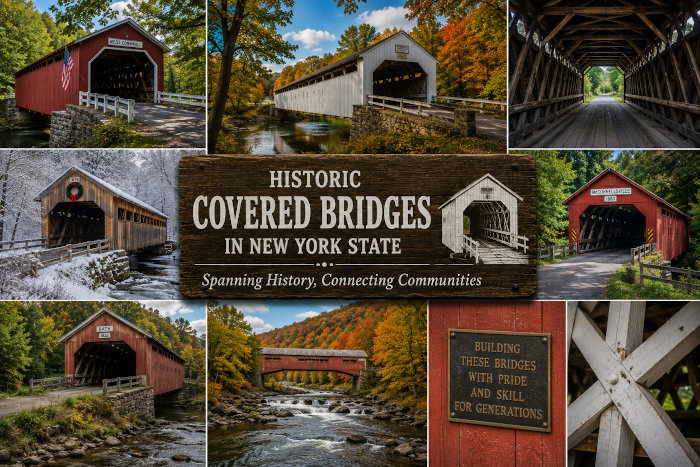
There is something about a covered bridge that makes you slow down.
Maybe it is the sudden transition from daylight into the shadow of a wooden structure.
Maybe it is the sound of tires, footsteps or horses crossing heavy wooden planks.
Maybe it is knowing that generations of people crossed the same stream through essentially the same doorway.
Or perhaps it is simply because a covered bridge looks as though it belongs to another time.
New York State once had hundreds of covered bridges. Today, only a small number of historic examples remain.
Those survivors are more than picturesque places to photograph.
They represent clever engineering, local craftsmanship, abundant forests, changing transportation and a very practical solution to a simple problem:
How do you make a wooden bridge last?
Why Were Bridges Covered?
It is easy to assume covered bridges were built to protect travelers from rain and snow.
That was certainly a pleasant benefit.
But the real reason was much more practical.
The roof and walls protected the bridge itself.
Early bridges were commonly constructed from wood. New York had abundant timber, and local builders understood how to work with it.
Wood is strong, renewable and remarkably useful.
But wood has an enemy.
Persistent moisture.
A large wooden bridge exposed continuously to rain, snow and sun could deteriorate relatively quickly. The massive structural timbers were expensive and difficult to replace.
Put a roof over them, however, and something changes.
The critical structural members remain much drier.
Instead of replacing an entire bridge, communities could periodically replace roofing, siding and individual floor planks.
The covering was essentially a protective shell around a much more valuable wooden structure.
A Barn Over a River?
In some ways, a traditional covered bridge resembles a long narrow barn.
There is a roof.
There is siding.
There is a heavy timber frame.
But unlike a barn, the entire structure must span open water while carrying its own weight plus horses, wagons, livestock and eventually motor vehicles.
That required some very clever woodworking.
The Secret Is the Truss
The most important part of many covered bridges is not the roof.
It is the truss hidden behind the walls.
A truss uses interconnected structural members, often arranged in triangles or repeating patterns, to distribute loads across a span.
Instead of relying on one enormous beam stretching from one bank to another, the truss allows many pieces of wood to work together.
Different bridge builders developed different truss designs.
Some used large diagonal timbers.
Others created repeating lattice patterns.
Some combined vertical, horizontal and diagonal members into remarkably sophisticated structures.
To a casual visitor, the inside of an old covered bridge may simply look like a collection of huge timbers.
To a bridge builder, those timbers are carefully directing forces from the roadway toward the abutments on either side.
The Town Lattice Truss
One particularly recognizable design is the Town lattice truss.
Instead of depending primarily on a few massive diagonal beams, the design uses many relatively smaller planks crossing one another in a lattice pattern.
Wooden pins connect the intersecting members.
The result resembles an enormous wooden web running along each side of the bridge.
The design had an important practical advantage.
Builders did not necessarily need exceptionally large timbers for every structural component. Smaller pieces could be assembled into a strong truss using techniques that could be reproduced by local builders.
It was an early example of making a complex structure from repeated, manageable components.
The Burr Arch-Truss
Another important bridge design combined a timber truss with a large wooden arch.
Known as the Burr arch-truss, it is associated with Theodore Burr, an important early American bridge designer who worked extensively in New York.
The large curved wooden arch provided additional support while the truss helped stiffen and distribute loads.
When you see one of these bridges from inside, the sweeping timber arch can be impressive.
It is both structure and craftsmanship.
Before Steel and Concrete
Today, we expect bridges to be made from steel and reinforced concrete.
In nineteenth-century rural New York, wood often made much more sense.
Trees were available locally.
Sawmills could prepare lumber.
Carpenters understood timber framing.
Materials did not need to be transported hundreds of miles.
A community could use nearby resources and local knowledge to solve a major transportation problem.
That made covered bridges not only engineering structures, but expressions of the communities that built them.
Built for Horses, Wagons and Livestock
Covered bridges were part of everyday transportation.
Farmers used them.
Children crossed them.
Livestock passed through them.
Wagons carrying crops, lumber and supplies traveled over their floors.
Before automobiles, the sound inside a bridge would have been very different.
Hooves striking wooden planks.
Wagon wheels rolling over boards.
Harnesses moving.
People talking.
Water flowing below.
For many rural communities, the covered bridge was simply part of the road.
Did the Cover Help Horses?
There is a long-standing idea that bridge walls helped keep horses from being frightened by rushing water below.
That may have been an additional benefit in some situations.
But it was not the primary reason for covering bridges.
The main purpose was longevity.
The roof protected the structural wood.
Sometimes the simplest explanation is the best one.
Why Did So Many Disappear?
If covered bridges worked so well, why are there so few left?
Part of the answer is changing transportation.
Horses and wagons became automobiles.
Automobiles became heavier trucks.
Roads became wider.
Traffic became faster.
Many old wooden bridges were too narrow or were not designed for the loads modern transportation demanded.
Floods, fires, ice, neglect and deterioration also took their toll.
In many places, replacing an old wooden bridge with a modern steel or concrete structure was simply the practical decision.
One by one, covered bridges disappeared from New York's roads.
The Bridges That Survived
The surviving historic covered bridges of New York are therefore special.
Some remain open to limited vehicle traffic.
Others serve pedestrians.
Some have been carefully restored.
Others have been relocated to parks or protected settings.
Each surviving bridge has its own story.
And several are worth building a New York road trip around.
Hyde Hall Covered Bridge
Located within Glimmerglass State Park near Cooperstown, the Hyde Hall Covered Bridge is particularly important because it dates to 1825.
That means its history reaches back to the same year the original Erie Canal was completed.
Think about that for a moment.
When New York was celebrating the opening of a revolutionary new water route across the state, this wooden bridge was also part of the landscape.
The bridge provides a remarkable connection to early nineteenth-century transportation and craftsmanship.
Its setting near Hyde Hall and Otsego Lake makes it especially appealing for anyone interested in combining architecture, history and scenery.
Downsville Covered Bridge
The Downsville Covered Bridge crosses the East Branch of the Delaware River in Delaware County.
Built in the nineteenth century, it is a wonderful example of how these bridges were integrated into small New York communities.
The bridge is not simply an isolated historic artifact.
It is part of the landscape and story of the Catskills and Delaware River region.
Places like Downsville remind us that covered bridges once formed an ordinary part of New York's transportation network.
Beaverkill Covered Bridge
The Beaverkill Covered Bridge in the Catskills occupies a particularly beautiful setting.
Surrounded by forest and spanning the Beaver Kill, the bridge combines engineering history with the natural landscape.
The Beaver Kill itself is famous in the history of American fly fishing, giving visitors another reason to explore the area.
This is one of those places where several New York stories meet:
Forests.
Rivers.
Transportation.
Craftsmanship.
Outdoor recreation.
Blenheim Covered Bridge
The story of the Blenheim Covered Bridge in Schoharie County demonstrates just how much people can value a historic structure.
The original bridge, constructed in the nineteenth century, became famous for its exceptionally long single span.
In 2011, catastrophic flooding associated with Tropical Storm Irene destroyed the historic bridge.
For many communities, that might have ended the story.
But Blenheim's covered bridge had become part of the identity of the area.
A replacement bridge was eventually constructed as part of an effort to restore that connection with the community's history.
The story raises an interesting question:
When the original structure is gone, can rebuilding still preserve something important?
Perhaps preservation is not always about saving every original board.
Sometimes it is also about preserving knowledge, appearance, memory and a sense of place.
Newfield Covered Bridge
The Newfield Covered Bridge in Tompkins County provides another opportunity to experience New York's covered bridge heritage.
Its location near the Finger Lakes makes it an easy addition to a trip already focused on waterfalls, wineries, state parks or the region's small communities.
That is one of the pleasures of discovering New York.
A bridge does not need to be the only reason for a trip.
It can become the unexpected stop that you remember.
Jay Covered Bridge
In the Adirondack community of Jay, a covered bridge crosses the East Branch of the Ausable River.
The setting is distinctly Adirondack, combining rushing water, mountain scenery and traditional architecture.
It is another example of why covered bridges have become destinations.
The bridge itself is interesting.
But so is everything around it.
Why Covered Bridges Photograph So Well
Covered bridges have become favorite photography subjects for good reason.
They naturally frame the landscape.
Stand inside one and look toward the opening.
The dark interior creates a frame around the brighter world outside.
A river, forest, road or snowy landscape becomes almost like a picture hanging at the end of the bridge.
The exterior provides equally interesting shapes: roof lines, weathered siding, stone abutments, wooden portals and reflections in the water.
And because the bridges change with the seasons, the same structure can produce completely different photographs in summer, fall and winter.
Look at the Wood
When visiting an old covered bridge, it is worth spending some time looking beyond the scenery.
Look at the structure itself.
Notice the size of the timbers.
Look for wooden pegs and joinery.
Follow the diagonals of the truss.
Notice where individual structural members meet.
Look at the floor and imagine how many hooves, wagon wheels, tires and footsteps have crossed it.
Look upward at the roof and remember that this relatively simple covering may be the reason the structure beneath it survived.
A covered bridge can be read almost like a woodworking lesson.
Repair Instead of Replace
Wooden structures offer another interesting advantage.
Individual pieces can often be repaired or replaced.
A damaged floor plank does not necessarily mean replacing the bridge.
Neither does deteriorated siding.
Even structural timbers can sometimes be carefully repaired or reproduced.
Over a long enough period, a historic wooden structure may contain materials from many different generations of repairs.
This leads to an interesting preservation question.
If a bridge has had its roof replaced, siding repaired, floor renewed and several timbers changed over two centuries, is it still the same bridge?
Most of us would probably say yes.
The structure has continued living.
Preservation Is Maintenance
Historic structures rarely survive because someone restored them once.
They survive because people continue taking care of them.
Roofs must remain watertight.
Drainage must be controlled.
Wood must be allowed to dry.
Damaged components must be repaired.
Foundations and abutments must remain stable.
Traffic loads must be controlled.
A covered bridge that has survived for 150 or 200 years has almost certainly received attention from many generations.
Preservation is not an event.
It is a process.
The Bridges Became Destinations
Like the Erie Canal, covered bridges have experienced an interesting transformation.
They were originally built because people needed to cross rivers.
Nobody needed to call them attractions.
They were infrastructure.
Today, people may drive miles specifically to see one.
They photograph them.
Walk through them.
Study their construction.
Include them in scenic drives.
Visit nearby villages and parks.
The practical structure has become part of the destination.
A Covered Bridge Road Trip
New York's surviving covered bridges are scattered around the state, which makes them particularly well suited to exploration.
Rather than trying to see them all at once, consider incorporating one or two into other trips.
- Combine a Catskills trip with historic covered bridges and trout streams.
- Look for bridges while exploring the Finger Lakes.
- Visit Hyde Hall and Glimmerglass State Park near Cooperstown.
- Include a covered bridge while traveling through the Adirondacks.
- Explore the Schoharie Valley's transportation and agricultural history.
- Return during fall foliage season and see the same structures in an entirely different landscape.
Before making a special trip, check current access information. Historic bridges occasionally close for maintenance or restoration, and some have restrictions on vehicle traffic.
More Than a Pretty Bridge
It is easy to look at a covered bridge and see nostalgia.
But look a little deeper.
You are looking at engineering.
You are looking at woodworking.
You are looking at locally available materials being used intelligently.
You are looking at transportation history.
You are looking at generations of maintenance and repair.
And you are looking at a remarkably simple idea that worked:
If you want the wooden bridge to last, put a roof over it.
Still Crossing Generations
The builders of New York's covered bridges were trying to solve practical problems.
They needed to get people, animals and goods across water.
They probably were not thinking about tourists photographing their work 150 or 200 years later.
But good practical design sometimes creates something more enduring than anyone expects.
The bridge connects two sides of a river.
The craftsmanship connects us with the people who built it.
The preservation connects one generation with another.
And the surviving bridges connect modern New Yorkers with a landscape that once looked very different.
Perhaps that is why we still stop when we see one.
We are not simply looking at an old bridge.
We are looking at a piece of New York that is still doing its job — connecting one side with the other.