042 The Erie Canal: Transportation... Now Destination
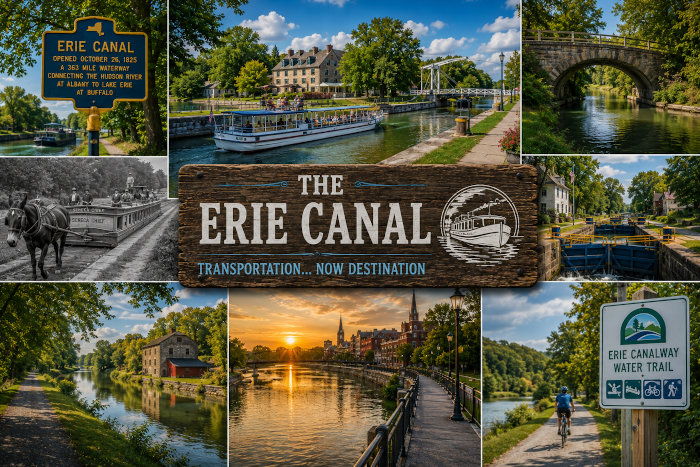
There was a time when the Erie Canal was not a place people visited for recreation.
It was infrastructure.
It was built to move flour, lumber, manufactured goods, farm products, people and opportunity across New York State.
It shortened distances, lowered transportation costs, helped cities grow and connected the interior of North America with the Atlantic Ocean.
Today, people return to the Erie Canal for an entirely different reason.
They ride bicycles beside it. They walk old towpaths. They paddle portions of it. They cruise through its locks. They visit canal towns, museums and historic sites. They photograph old stone structures and watch modern boats pass through a transportation system whose roots reach back more than two centuries.
The Erie Canal began as a way to get somewhere else.
It has become somewhere worth going.
A Geographic Problem
To understand why the Erie Canal mattered so much, it helps to look at a map.
The Appalachian Mountains created a tremendous obstacle between the Atlantic Coast and the interior of the young United States. Moving people and freight over land was slow, difficult and expensive.
New York, however, possessed something unusual.
The Hudson River provided a natural route north from New York City toward Albany, while the Mohawk River valley created a relatively low passage westward through the mountains.
Long before construction of the Erie Canal, Native peoples understood and traveled these interconnected waterways and land routes. Later European traders and settlers also recognized their importance.
The geography was already pointing toward a transportation corridor.
The challenge was figuring out how to connect it.
An Enormous Idea
In the early 1800s, the idea of digging a canal hundreds of miles across New York sounded extraordinarily ambitious.
There were no excavators.
No bulldozers.
No diesel-powered earth-moving equipment.
Much of the work would be accomplished with human labor, horses, hand tools, primitive machinery and an enormous amount of problem solving.
New York State authorized construction in 1817.
The original Erie Canal would ultimately stretch approximately 363 miles between the Hudson River and Lake Erie. It was initially only about 40 feet wide and four feet deep.
Yet that relatively narrow ribbon of water would dramatically alter New York State and the young nation.
Building Without a Blueprint
One of the most fascinating parts of the Erie Canal story is that the people building it were often solving engineering problems as they encountered them.
They had to move water across changing elevations.
They had to cross rivers and streams.
They had to excavate through forests, wetlands, rock and difficult soils.
They constructed locks to raise and lower boats, aqueducts to carry the canal across natural waterways, embankments to hold water above the surrounding landscape and channels capable of maintaining navigable depths.
The canal became an enormous practical engineering classroom.
Solutions developed during its construction helped build American engineering knowledge and confidence.
The Locks Made the Impossible Possible
Water does not naturally flow uphill.
That simple fact created one of the canal's greatest engineering challenges.
Lake Erie sits hundreds of feet higher than the Hudson River.
Locks provided the solution.
A boat entered a chamber and gates closed behind it. Water was then added or removed, raising or lowering the boat until it reached the elevation of the next section of canal.
The gates opened, and the boat continued on its journey.
Today, watching a boat travel through a canal lock can seem peaceful and almost routine.
But stop and think about what is actually happening.
An entire boat is essentially being carried uphill or downhill using controlled water and gravity.
It is beautifully simple engineering.
1825: The Canal Opens
After eight years of construction, the Erie Canal officially opened in 1825.
Governor DeWitt Clinton traveled aboard the Seneca Chief from Buffalo to New York Harbor.
At the conclusion of the journey, water carried from Lake Erie was poured into the Atlantic Ocean in the symbolic “Wedding of the Waters.”
For the first time, a navigable water route connected the Great Lakes with the Hudson River and ultimately the Atlantic.
New York's geography had changed.
And so had its future.
Transportation Changes Everything
The canal dramatically reduced the cost and difficulty of moving freight.
Products from farms and communities farther west could travel east toward major markets.
Manufactured goods could move west.
People could travel into the interior more efficiently than before.
New businesses appeared.
Warehouses were built.
Ports became communities.
Communities became towns.
Towns became cities.
Buffalo, Rochester, Syracuse, Utica and numerous smaller communities were profoundly shaped by the canal corridor.
New York City also gained enormous economic advantages as increasing amounts of inland commerce traveled through the Hudson River to its harbor.
The Canal Helped Build the Empire State
The nickname “Empire State” has several possible historical origins, but there is little question that the Erie Canal helped New York become an economic powerhouse.
The canal connected agriculture, natural resources, manufacturing, population centers and an Atlantic port within one transportation network.
Its influence extended far beyond New York.
Goods and people could move between eastern markets and the Great Lakes, opening stronger connections with the Midwest and encouraging other states to build canals of their own.
The Erie Canal was not simply a successful New York project.
It became a model.
The Mule and the Towpath
Before powered canal boats became common, many boats moved using perhaps the most recognizable member of the canal workforce: the mule.
Mules and horses walked along paths beside the canal while pulling boats through the water with long towlines.
These became known as towpaths.
The animals could move extremely heavy loads by water compared with what they could haul in wagons over early roads.
It was slow transportation by modern standards, but efficiency matters more than speed when comparing technologies from different eras.
For its time, the canal was revolutionary.
And those old towpaths would eventually find another life.
The Canal Keeps Changing
The success of the original Erie Canal quickly demonstrated its limitations.
More traffic meant a need for larger boats and greater capacity.
The canal was enlarged during the nineteenth century, and in the early twentieth century New York developed the much larger Barge Canal system.
Sections were relocated. Rivers and lakes became parts of the navigation system. Larger locks and channels accommodated larger vessels.
The canal people see today is therefore not simply the narrow 1825 ditch preserved unchanged.
It is a transportation system that has repeatedly evolved.
That makes exploring it particularly interesting.
Depending on where you travel, you may encounter the modern canal, abandoned sections of earlier canals, stone lock chambers, aqueduct remains, historic towpaths and communities shaped by several generations of canal development.
Then Came the Railroad
Technology rarely stops with one successful invention.
Railroads eventually offered faster transportation without many of the limitations faced by canals.
Trains did not need a continuous channel of water. They were less affected by seasonal navigation closures and could reach places where canal construction would have been impractical.
Later, improved highways and trucks provided another level of flexibility.
The Erie Canal's role as the dominant transportation system declined.
It would have been easy for the canal to become merely an artifact of an earlier age.
Instead, something interesting happened.
Transportation Became Recreation
The very characteristics that once made the canal valuable for commerce began making it attractive for recreation.
The waterway was long.
Relatively level land followed much of its route.
Historic communities were already positioned along it.
Old towpaths provided natural corridors for walking and bicycling.
The canal connected parks, villages, cities, museums, historic sites and natural areas.
A transportation route was becoming a recreational route.
The Towpath Gets Another Job
Imagine telling a nineteenth-century mule driver that someday people would travel beside the canal purely because they wanted exercise and scenery.
It might have been difficult to explain.
Today, portions of the old canal towpath form part of an extensive trail network used by walkers, runners and bicyclists.
The Erie Canalway Trail extends across New York and is incorporated into the larger Empire State Trail.
A path originally created so animals could pull freight boats has become recreational infrastructure.
That is a wonderful example of adaptive reuse on an enormous scale.
Traveling the Canal by Bicycle
Bicycling may be one of the best modern ways to understand the scale of the Erie Canal.
A cyclist moves slowly enough to notice old structures, communities, waterways and changes in the landscape, but quickly enough to cover substantial distances.
Some riders explore a short section near home.
Others make day trips between canal communities.
And ambitious cyclists can turn the corridor into a multi-day journey across New York State.
The destination is no longer simply the place at the end of the ride.
The canal corridor itself becomes the destination.
Walking the Canal
You do not need to travel hundreds of miles to enjoy the canal.
A short walk along a towpath or waterfront can reveal layers of history.
Look carefully.
An unusually straight depression may be an abandoned canal channel.
A large stone structure beside a creek may be part of an old aqueduct or lock.
An old warehouse may have faced the canal rather than today's highway.
A community park may occupy land that once bustled with freight boats, workers and animals.
Once you begin recognizing canal features, the landscape starts telling its story.
Getting Back on the Water
The Erie Canal remains a functioning waterway.
Recreational boaters can travel portions of the system, pass through operating locks and experience the canal from the same basic perspective as generations of earlier travelers: from the water.
Today's experience, however, is usually much more leisurely.
Boaters can stop in canal communities, visit restaurants and historic sites, explore waterfront parks or simply enjoy moving slowly through New York.
The canal can also be experienced by kayak and canoe in suitable areas.
The New York State Canalway Water Trail provides opportunities for paddlers to explore sections of the canal system and connected waterways.
The Locks Are Still Fascinating
Locks are among the easiest canal features to appreciate because visitors can watch the engineering work in real time.
A boat enters.
The gates close.
The water level changes.
The boat rises or falls.
The next gates open.
And the journey continues.
The basic principle that helped make the Erie Canal possible more than two centuries ago remains understandable to anyone standing nearby and watching.
That makes canal locks wonderful places for children, adults, engineers, history enthusiasts and anyone who simply enjoys seeing how things work.
Canal Towns Became Destinations Too
The Erie Canal's legacy is not limited to the water.
Communities along its route developed around transportation, commerce and industry.
Today those same communities may offer restaurants, shops, museums, waterfront parks, historic architecture, festivals and public docks.
Places that once depended on travelers passing through can now benefit from travelers deliberately stopping.
That represents another reversal in the canal story.
Commerce once created the towns.
Now the history and character of those towns help support tourism.
Look for the Older Canal
One of the most rewarding ways to explore the Erie Canal is to realize there is more than one Erie Canal landscape.
The original canal was enlarged and rerouted over time.
Sections that were once critical transportation corridors were later abandoned.
Some remain surprisingly visible.
You may discover:
- Old stone locks hidden near modern roads
- Abandoned canal channels
- Historic aqueduct remains
- Former towpaths
- Canal-era warehouses and industrial buildings
- Museums containing boats, tools and canal artifacts
- Communities whose street patterns still reflect the old waterway
The canal becomes almost an outdoor archaeological site stretching across New York State.
A Corridor of Museums and Historic Places
Because the canal influenced so many communities, its history can be explored in many different ways.
Some museums focus directly on canal construction and transportation.
Others tell the stories of the communities, industries and people that developed alongside it.
Historic sites can help visitors understand engineering, immigration, commerce, social movements and everyday life during the canal era.
Rather than thinking of the Erie Canal as one attraction, it may be better to think of it as a thread connecting hundreds of attractions.
Nature Returned Too
Although the canal is human-made infrastructure, portions of the canal corridor have developed into valuable green spaces.
Water, wetlands, wooded edges and undeveloped sections can provide habitat for birds, turtles, fish and other wildlife.
A morning bicycle ride may therefore include an old lock, a nineteenth-century village, a great blue heron and a modern pleasure boat within only a few miles.
History and nature have become intertwined.
Exploring Slowly Has Advantages
Modern transportation encourages us to move quickly.
Interstates are designed to get us past communities.
The canal encourages almost the opposite behavior.
Walk.
Pedal.
Paddle.
Cruise.
Stop at the next village.
Read the historical marker.
Watch a lock operate.
Have lunch beside the water.
Continue when you are ready.
It is transportation without the pressure to arrive quickly.
The Erie Canalway National Heritage Corridor
Today, the broader Erie Canalway National Heritage Corridor stretches more than 500 miles across upstate New York and includes the Erie, Champlain, Oswego and Cayuga-Seneca canals and their historic alignments.
The corridor recognizes that the story is much larger than a single water channel.
It includes communities, historic buildings, natural landscapes, museums, parks, trails and cultural resources that together tell the canal story.
This makes it possible to explore the Erie Canal in many ways without ever attempting to travel its entire length.
200 Years Later
In 2025, New York celebrated the bicentennial of the Erie Canal's completion.
Two hundred years is an extraordinary lifespan for transportation infrastructure.
The canal system has changed enormously since 1825, yet it has remained in continuous operation.
Few transportation projects have influenced their state so profoundly and then successfully reinvented themselves for later generations.
A Wonderful Example of Reinvention
We often think preservation means freezing something at a particular moment in history.
The Erie Canal suggests another possibility.
Preservation can include continued use.
An old towpath can become a bicycle trail.
A freight waterway can welcome recreational boats.
A commercial port can become a waterfront park.
An old lock can become an outdoor classroom.
A canal town can use its history to attract new visitors.
The original purpose is respected without requiring the future to look exactly like the past.
Planning an Erie Canal Adventure
You can experience the canal in almost any way that fits your interests and available time.
- Walk: Explore a local towpath, historic lock or canal-side park.
- Bike: Ride a section of the Erie Canalway Trail or plan a longer journey.
- Paddle: Explore appropriate sections of the Canalway Water Trail by canoe or kayak.
- Boat: Travel the operating canal and experience its locks firsthand.
- Drive: Visit canal towns, museums, engineering sites and historic districts.
- Learn: Look for original canal sections, stone locks, aqueducts and interpretive sites.
- Stay: Make canal communities part of a multi-day New York trip rather than simply passing through them.
For maps, current navigation information, recreation opportunities and trip-planning resources, visit the New York State Canal Corporation and the Erie Canalway National Heritage Corridor.
Transportation... Now Destination
Perhaps the most remarkable thing about the Erie Canal is that it still connects New York.
The meaning of that connection has simply changed.
In 1825, the goal was to move goods and people efficiently between the Great Lakes and the Hudson River.
The canal helped farms reach markets.
It helped cities grow.
It helped New York City become an international commercial center.
It encouraged migration and connected regions that had previously seemed far apart.
Today, it connects us with something else.
Our history.
Our communities.
Our landscape.
And sometimes simply with the pleasure of traveling more slowly.
The Erie Canal was built because people needed a better way to get somewhere.
Two centuries later, we have discovered another reason to follow it.
Sometimes the journey itself is where we wanted to go.