044 Underground Railroad in New York State
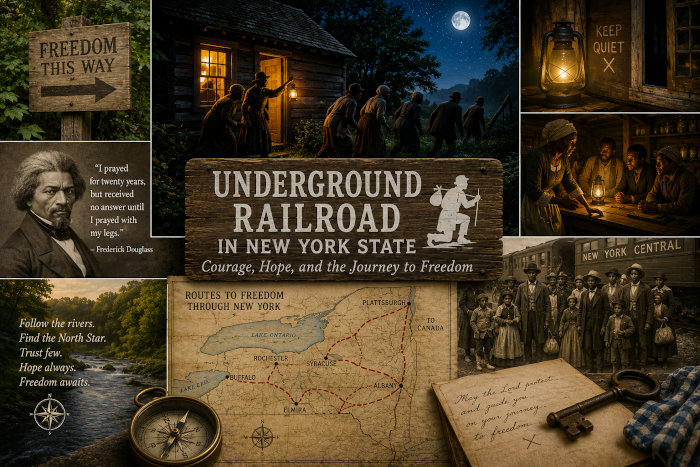
There was no railroad.
There were no tracks.
There was no single route marked on a map.
And for many of the people traveling it, there was no guarantee that the next house, town, wagon, boat or person would lead to safety.
The Underground Railroad was a network of people, places, transportation routes and acts of courage that helped enslaved people escape toward freedom.
New York State became one of the most important parts of that story.
Its location mattered.
Its roads and waterways mattered.
Its growing cities mattered.
Its free Black communities mattered.
Its abolitionists mattered.
And perhaps most importantly, the determination of freedom seekers themselves mattered.
Not Really a Railroad
The term “Underground Railroad” can create the impression of a highly organized secret transportation system.
The reality was more complicated.
There were established networks in some communities, trusted contacts in others and well-known abolitionists who repeatedly assisted people seeking freedom.
But many escapes also began without assistance.
Freedom seekers might travel alone or in small groups, sometimes receiving help only after reaching a northern community.
Some traveled on foot.
Others used wagons, ships, canal boats or trains when circumstances allowed.
Some assistance was carefully planned.
Other assistance happened because an individual was suddenly asked to help another human being in danger.
The Underground Railroad was not one organization.
It was resistance connected by people.
Freedom Seekers Were the Center of the Story
When discussing the Underground Railroad, it is easy to focus primarily on the people who provided shelter or transportation.
Those people were important.
But the story begins with the freedom seekers themselves.
They made the decision to escape slavery.
They faced the greatest danger.
They left behind familiar places and often family members without knowing exactly what awaited them.
They navigated unfamiliar landscapes, avoided capture and searched for people they could trust.
Calling them simply “passengers” can miss something important.
They were active participants in their own liberation.
Why New York Mattered
New York occupied a powerful geographic position.
To the south were states where slavery remained legal.
To the north was Canada.
Between them stretched New York's cities, farms, roads, rivers, canals, railroads and communities.
For some freedom seekers, New York was the destination.
For others, it was the final major stage before reaching Canada.
This made the state a crossroads.
New York Was Free, But Not Always Safe
New York had abolished slavery by the nineteenth century, but reaching New York did not necessarily mean reaching permanent safety.
Federal law allowed people who had escaped slavery to be pursued and returned.
The Fugitive Slave Act of 1850 made the danger even greater by strengthening federal efforts to recover freedom seekers and penalizing people who aided them.
As a result, some people who had already reached northern states chose to continue into Canada.
The international border could mean the difference between living under the threat of recapture and living beyond the reach of American fugitive-slave law.
Geography Created Routes
Just as geography influenced the Erie Canal, geography influenced freedom journeys through New York.
Rivers, roads and later railroads often determined how people traveled.
Major communities such as New York City, Albany, Syracuse, Rochester and Buffalo became important points within different networks.
Some journeys moved north through the Hudson Valley.
Others crossed central New York toward Rochester and Niagara.
Still others traveled through the North Country toward the Canadian border.
The routes varied because the circumstances varied.
New York City
New York City was both an important gateway and a dangerous place.
It contained a large free Black population, abolitionist organizations and people willing to help freedom seekers.
But the city also had strong economic connections with the slaveholding South and people involved in capturing and returning fugitives.
That combination made New York City complicated.
A person might find assistance there.
That same person might also face capture.
From New York City, some freedom seekers traveled north toward Albany or west toward other abolitionist communities.
Albany and the Stephen and Harriet Myers Residence
Albany became an important link in northbound freedom journeys.
One of the most significant surviving places connected with that work is the Stephen and Harriet Myers Residence.
Stephen Myers had escaped slavery earlier in his life and became a leading Black abolitionist.
He and Harriet Myers worked with the Albany Vigilance Committee, which assisted freedom seekers arriving in the city and helped them settle locally or continue toward greater safety.
Their home reminds us of something essential about Underground Railroad history:
Free Black communities were not simply recipients of abolitionist assistance.
They were leaders, organizers, fundraisers, writers, guides and protectors.
Syracuse
Syracuse developed into another important anti-slavery center.
Its location placed it along transportation routes moving through central New York.
The city also became known for open resistance to enforcement of fugitive-slave laws.
People did not always quietly hide their opposition to slavery.
Sometimes communities actively confronted attempts to capture freedom seekers.
This distinction matters.
The Underground Railroad was secret when secrecy was necessary.
But the larger abolition movement could also be very public.
Rochester and Frederick Douglass
Rochester became one of the most important anti-slavery communities in New York.
Frederick Douglass moved there in the late 1840s and established his abolitionist newspaper, The North Star.
Douglass had himself escaped slavery and became one of the most influential voices against it.
In Rochester, Frederick Douglass and his wife, Anna Murray-Douglass, also assisted freedom seekers.
Their home became part of the network helping people continue toward Canada.
Rochester's location made it particularly important because travelers could continue west toward Niagara or other Canadian crossings.
The city combined transportation, activism, publishing and a strong reform community.
Anna Murray-Douglass
Frederick Douglass is one of the most famous Americans associated with abolition, but the Underground Railroad story becomes more complete when we also remember Anna Murray-Douglass.
Anna was born free and helped Frederick Douglass escape slavery before they married.
Later, she helped maintain the household and family while Douglass traveled extensively and worked as a public abolitionist.
Their Rochester home also supported freedom seekers.
Underground Railroad history contains many people whose contributions were vital even though their names became less famous.
Harriet Tubman and Auburn
Few people are more closely associated with the Underground Railroad than Harriet Tubman.
Born enslaved in Maryland, Tubman escaped and then repeatedly returned south to help others reach freedom.
Eventually, she chose Auburn, New York, as her home.
Auburn already had a strong abolitionist community and connections to Underground Railroad activity.
In 1859, Tubman acquired property there and created the home base she had long lacked.
Her story in New York is particularly meaningful because Auburn represents something beyond escape.
It represents life after escape.
Family.
Home.
Community.
Ownership.
The opportunity to build a future.
William and Frances Seward
Auburn was also home to William Seward, who would later serve as governor of New York, United States senator and secretary of state.
His wife, Frances Seward, held strong anti-slavery views and was connected with abolitionist activity in Auburn.
The Seward family became part of the community in which Harriet Tubman eventually established her home.
These relationships demonstrate how Underground Railroad networks often grew through trust between individuals.
One connection led to another.
Peterboro and Gerrit Smith
The small Madison County community of Peterboro became nationally important in the anti-slavery movement.
It was home to Gerrit Smith, a wealthy reformer and abolitionist who used substantial portions of his fortune to support anti-slavery work and assist Black Americans.
Smith supported people seeking freedom, financed reform efforts and provided land to Black New Yorkers.
Peterboro reminds us that major historical movements do not occur only in major cities.
A small rural community can become a center for ideas capable of influencing an entire nation.
Niagara: Freedom Within Sight
Few places make the geography of the Underground Railroad more dramatic than Niagara Falls.
Canada lies directly across the Niagara River.
For freedom seekers arriving there, the distance between danger and a greater degree of legal safety could sometimes be measured in less than a mile.
Niagara became increasingly important as transportation improved.
Rail connections brought travelers from major eastern cities toward the border.
Harriet Tubman herself guided freedom seekers across the international boundary in the Niagara region.
Today, the Niagara Falls Underground Railroad Heritage Center helps tell this often-overlooked part of the city's history.
Tourist Destination and Freedom Crossing
Niagara Falls was already becoming a major tourist attraction during the nineteenth century.
Visitors arrived to see one of the world's great natural wonders.
At the same time, freedom seekers arrived for an entirely different reason.
To one person, the Niagara River represented scenery.
To another, it represented a border.
And across that border was Canada.
The same landscape could mean very different things depending on who was standing beside it.
The North Country
Northern New York also played an important role because of its proximity to Canada.
Routes through communities near Lake Champlain and the Canadian border provided alternatives to the better-known Niagara corridor.
The landscape could be difficult.
Forests, mountains, weather and long distances created challenges.
But isolation could also provide opportunities to avoid capture.
Today, museums and historic resources throughout northern New York continue researching and preserving these stories.
Transportation Could Help — and Create Risk
Transportation improvements changed Underground Railroad activity.
Canals, steamships and railroads made long-distance travel faster.
A journey that once required many days on foot might include transportation over part of the route.
But public transportation also created exposure.
Tickets might need to be purchased.
Officials could ask questions.
Stations brought crowds.
Slave catchers understood transportation networks too.
The same infrastructure that made escape faster could make concealment more difficult.
The Erie Canal Connection
Our previous Discover New York State topic explored how the Erie Canal transformed transportation.
That same transportation corridor also became part of the world through which freedom seekers and abolitionists moved.
Canal communities grew rapidly.
Roads and railroads increasingly connected them.
Information and people moved through the same corridor.
The canal's influence therefore reached far beyond freight and commerce.
Transportation networks change what is possible.
Sometimes that has consequences their builders never imagined.
Free Black Communities Were Essential
For many years, popular Underground Railroad stories emphasized white abolitionists hiding escaped slaves in secret rooms.
Those stories sometimes reflected real assistance.
But they can leave out one of the most important parts of the history.
Black Americans were central to Underground Railroad activity.
Some had escaped slavery themselves.
Others had been born free.
They organized vigilance committees.
Provided shelter.
Raised money.
Shared information.
Arranged transportation.
Published newspapers.
Warned communities when slave catchers appeared.
And sometimes directly confronted attempts to capture freedom seekers.
The story was not simply one group rescuing another.
It was also a story of Black resistance, organization and leadership.
Churches and Faith Communities
Churches frequently became important parts of abolitionist networks.
Black churches in particular provided community organization, communication and assistance.
Quaker communities also became strongly associated with anti-slavery activity in portions of New York.
But no religious or ethnic group acted with complete unity.
Some people opposed slavery actively.
Others opposed abolition.
Still others remained silent.
History is rarely as simple as assigning one position to an entire community.
The Danger of Helping
Assisting a freedom seeker could carry serious consequences.
Federal law could punish people who obstructed capture or provided assistance.
There could also be social, political and financial consequences.
For Black abolitionists, the personal danger could be particularly severe.
Yet people continued to help.
Some provided a meal.
Some provided a bed.
Some drove wagons.
Some raised money.
Some printed newspapers.
Some offered legal help.
And some opened the door when someone in danger knocked.
Why So Many Stories Are Difficult to Verify
Almost every old community seems to have a house rumored to contain an Underground Railroad tunnel or secret room.
Some stories are true.
Some may contain pieces of truth.
Others developed decades later.
Secrecy creates an obvious problem for historians.
People participating in illegal resistance did not always create detailed written records.
But that does not mean every local tradition should automatically be accepted as fact.
Historians look for letters, diaries, newspapers, legal records, memoirs, census information, organizational records and other evidence that can establish connections.
This is why documented sites are particularly valuable.
The Myth of the Secret Tunnel
Hidden rooms and tunnels make exciting stories.
They certainly existed in some historical contexts.
But a building does not need a secret tunnel to have participated in the Underground Railroad.
A kitchen table could be enough.
A barn.
A wagon.
A church.
A newspaper office.
A railroad station.
A person who knew where to send someone next.
The network depended more upon human relationships than architectural tricks.
Following the North Star
The North Star became a powerful symbol of freedom because it could help travelers orient themselves toward the north.
Frederick Douglass chose The North Star as the name of his Rochester newspaper.
The title connected abolitionist journalism with the broader symbolism of northward movement and freedom.
But real journeys required far more than simply following one star.
Travelers needed food, shelter, geographic knowledge, luck and extraordinary courage.
What Did Canada Mean?
Canada did not represent a perfect world free from racism and discrimination.
But for many freedom seekers, crossing into British territory meant escaping the reach of United States fugitive-slave laws.
Some settled permanently in Canadian communities.
Others later returned to the United States.
For those standing near the Niagara River or approaching the northern border, Canada represented something immediate:
A place where a person who had escaped slavery could no longer legally be returned under American fugitive-slave law.
Exploring Underground Railroad History Today
New York contains many places where visitors can explore this history.
Among them are:
- Harriet Tubman National Historical Park — Auburn: Explore Tubman's life, home and community in freedom.
- Stephen and Harriet Myers Residence — Albany: Learn about Black abolitionist leadership and Albany's Vigilance Committee.
- Niagara Falls Underground Railroad Heritage Center: Discover the importance of Niagara as an international crossing point.
- Gerrit Smith Estate — Peterboro: Explore the abolition movement and the extraordinary reform community surrounding Gerrit Smith.
- Rochester: Follow the legacy of Frederick Douglass, Anna Murray-Douglass and the city's abolitionist community.
- North Country historic resources: Explore stories connected with routes toward the Canadian border and Lake Champlain.
Because research continues and some historic sites are privately owned, always verify current public access before visiting.
The National Underground Railroad Network to Freedom
The National Park Service maintains the National Underground Railroad Network to Freedom, which identifies sites, programs and research facilities with documented connections to Underground Railroad history.
The program includes hundreds of locations across the United States, including many in New York.
This can be an excellent starting point for anyone wanting to distinguish documented history from local legend.
Visit the National Park Service Underground Railroad resources to explore verified sites and stories.
Look Beyond the Famous Names
Harriet Tubman, Frederick Douglass and Gerrit Smith are important figures.
But the Underground Railroad could not have functioned through a few famous individuals.
It depended upon people whose names may never be known.
A farmer who offered shelter.
A boat worker who looked the other way.
A Black family that shared food.
A minister who provided information.
A wagon driver who traveled after dark.
A person who guided someone toward the next community.
And above all, the freedom seekers who kept moving.
Ordinary Landscapes, Extraordinary History
One of the most powerful things about exploring Underground Railroad history in New York is how ordinary many of the places appear today.
A city street.
A farmhouse.
A river crossing.
A church.
A village road.
A railroad corridor.
Yet in another era, those places could have been connected with decisions involving freedom, danger and human dignity.
History does not always announce itself with a monument.
Sometimes we have to learn enough to recognize the landscape differently.
Movement Across New York
In our recent Discover New York State topics, we have explored transportation.
The Erie Canal moved freight and transformed commerce.
Covered bridges helped communities cross rivers.
The Underground Railroad also involved movement across New York.
But this movement was fundamentally different.
The destination was not a marketplace.
It was not a western town.
It was not simply the other side of a river.
For people escaping slavery, the destination was control over their own lives.
The Most Important Direction Was Forward
Maps can show us New York City, Albany, Syracuse, Rochester, Auburn, Niagara and the Canadian border.
They can show rivers and roads.
They can show distances.
What maps cannot fully show is the human experience of traveling those routes while knowing capture could mean a return to slavery.
That is why the Underground Railroad should never be reduced to a collection of quaint secret rooms or interesting old houses.
It is a story about people refusing to accept enslavement.
It is a story about communities deciding whether they would help.
It is a story about courage expressed in many different forms.
And New York State became one of the landscapes through which that struggle passed.
The routes were different.
The journeys were different.
The people were different.
But they shared something fundamental.
They were moving toward the right to decide where their own lives would go next.