050 Hops in New York State: From Farm Fields to Craft Brewing
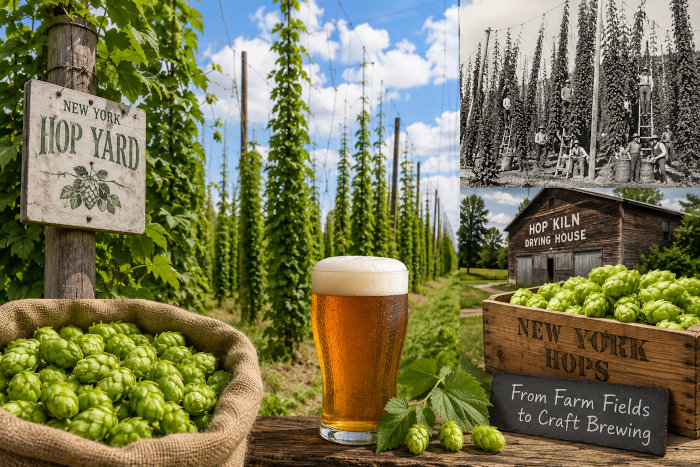
Walk past a mature hop yard in late summer and one thing immediately stands out.
Height.
Hop plants climb tall trellises and can stretch many feet into the air during a single growing season.
They look almost like a wall of green.
Hidden among the leaves are the small cone-shaped flowers that make the plant so important.
Those cones are hops.
And for generations, New York farmers grew enormous quantities of them.
Today, hops have found a new place in the state's agricultural landscape through craft brewing, local farming and renewed interest in regional ingredients.
A small flower helped build an industry, nearly disappeared from New York farms, and then found its way back.
What Exactly Is a Hop?
Hops are the flowers of the hop plant, Humulus lupulus.
The plant is a perennial.
Its underground crown and roots survive from year to year, while most of the above-ground growth dies back after the growing season.
Each spring, new shoots emerge.
Then they begin climbing.
And climbing.
And climbing.
By summer, a hop yard can become a remarkably tall agricultural landscape.
Bines, Not Vines
People often call hops vines.
Botanically, they are more accurately described as bines.
A vine may climb using tendrils, suckers or other specialized structures.
A bine climbs by wrapping its stem around a support.
Hop bines naturally spiral upward around strings or other supports.
Give them something to climb and they know what to do.
Why Grow Them So Tall?
Hop plants naturally grow vigorously upward.
Commercial growers take advantage of that behavior by constructing tall trellis systems.
Heavy posts support cables above the field.
Strings hang downward.
Hop shoots are trained onto the strings.
The plants then climb toward the sunlight.
Growing vertically allows a large amount of plant material to occupy a relatively small footprint.
Male and Female Plants
Hop plants are unusual because male and female flowers typically grow on separate plants.
Commercial hop production generally relies on female plants because they produce the cones used in brewing.
Growers usually avoid male plants in production yards so the flowers remain largely unpollinated.
The cone itself contains the compounds brewers want.
Look Inside a Hop Cone
Pull apart a ripe hop cone and you may notice a yellow powdery material near its base.
This is lupulin.
Lupulin glands contain many of the resins and aromatic oils responsible for the characteristics hops contribute to beer.
The cone may look delicate.
Chemically, it is packed with powerful compounds.
Why Put Hops in Beer?
Beer is made primarily from water, malted grain, yeast and hops.
Each ingredient has a job.
Malted grain provides sugars that yeast can ferment.
Yeast converts those sugars into alcohol and carbon dioxide.
Hops contribute bitterness, aroma and flavor.
They can also help balance the natural sweetness that comes from malt.
Without hops, many beers would taste much sweeter.
Bitterness and Aroma Are Not the Same Thing
Brewers can use hops differently depending on when they are added.
Hops boiled for a longer time tend to contribute more bitterness.
Hops added later preserve more of their aromatic oils.
Additional hops may even be added after active boiling or during fermentation in a process commonly called dry hopping.
The same plant can therefore contribute very different qualities depending on how it is used.
What Does a Hop Smell Like?
Different hop varieties can produce remarkably different aromas.
People may describe them as:
- Citrusy
- Floral
- Herbal
- Spicy
- Pine-like
- Earthy
- Tropical
- Fruity
Those descriptions are not simply marketing terms.
Hop cones contain complex mixtures of volatile aromatic compounds.
The variety, growing conditions, harvest timing and handling all influence what eventually reaches the glass.
New York Was Once Hop Country
During the nineteenth century, New York became one of the most important hop-growing regions in the United States.
Central New York in particular developed a major hop industry.
Farmers grew hops as an important cash crop.
Hop yards became common parts of the agricultural landscape.
Harvest required large amounts of seasonal labor.
For some communities, hops were not a novelty.
They were business.
Why New York?
New York offered a combination of conditions that supported hop production.
Summer sunlight.
Cold winters.
Suitable soils.
Reliable rainfall in many areas.
Established farms.
And proximity to major population centers and transportation routes.
Once farmers gained experience with the crop, hop production became part of the regional agricultural economy.
Hop Picking Was Work
Harvesting hops historically required enormous amounts of hand labor.
The long bines had to be brought down.
Cones were picked from the plants.
Large harvest crews worked during a relatively short seasonal window.
Families and temporary workers could all become involved.
Like many agricultural harvests, timing mattered.
Too early and the cones were not fully mature.
Too late and quality declined.
The Hop House
Fresh hop cones contain far too much moisture for long-term storage.
They must be dried soon after harvest.
Traditional hop farms therefore needed drying facilities, often called hop houses or hop kilns.
Warm air moved through layers of freshly harvested cones.
Moisture was removed.
Once dried, hops could be packed and transported.
The drying process had to be carefully managed because excessive heat could damage aroma and quality.
Harvest Is a Race Against Time
Fresh hops begin changing as soon as they are picked.
Heat and moisture can degrade quality.
That means harvest, transportation and drying must happen quickly.
Modern hop growers still deal with the same basic challenge.
The plant may have taken an entire season to produce the crop.
Once picked, the cones cannot wait around very long.
How Do You Know When Hops Are Ready?
A mature hop cone changes in texture and aroma.
The cone becomes lighter and more papery.
Lupulin inside becomes more developed and aromatic.
Growers may evaluate moisture, appearance, aroma and laboratory measurements before deciding when to harvest.
Like grapes or apples, the best harvest date is a balance between biology and weather.
Weather Can Change Everything
Hop farmers depend heavily on weather.
Too much rain can increase disease pressure.
Drought can reduce growth.
Wind can damage trellis systems.
Excessive humidity can contribute to fungal problems.
Storms near harvest can complicate an already narrow harvest window.
Growing hops may look romantic from the road.
It is still farming.
Disease Changed the Industry
New York's hop industry eventually declined dramatically.
Plant diseases were part of the problem.
Downy mildew and other diseases can seriously damage hop plants and reduce yields.
Managing disease in humid eastern growing regions can be challenging.
Meanwhile, hop production was expanding elsewhere in the United States.
The Industry Moves West
Over time, large-scale American hop production shifted toward the Pacific Northwest.
Washington, Oregon and Idaho developed major commercial hop industries.
Climate, growing conditions, irrigation and large-scale production gave western growers significant advantages.
New York's once-dominant hop landscape faded.
Fields disappeared.
Hop houses were abandoned or converted to other uses.
A crop that had once defined parts of rural New York became relatively uncommon.
Prohibition Did Not Help
Then came Prohibition.
When commercial alcohol production was severely restricted, demand for brewing ingredients changed dramatically.
For a New York hop industry already facing competition and disease problems, the disruption was another major blow.
By the time legal brewing returned, western hop-growing regions had become well established.
For Decades, Hops Were Mostly History
Old photographs remained.
Farm stories remained.
Occasional hop houses survived.
But the large fields of tall hop trellises were mostly gone from New York.
It would have been easy to assume the crop would never return in a meaningful way.
Then American brewing began changing.
The Craft Brewing Revolution
Small breweries began appearing across the United States.
Brewers experimented with styles.
Consumers became increasingly interested in distinctive flavors and local products.
Hops moved into the spotlight.
India pale ales and other hop-forward beers helped make hop variety names familiar to consumers.
Suddenly people wanted to know:
Which hops are in this beer?
Local Beer Creates Local Demand
As craft breweries expanded in New York, interest in locally grown brewing ingredients increased too.
Malt could be produced from New York grain.
Hops could be grown again on New York farms.
Brewers could create beverages tied more closely to local agriculture.
The idea was appealing to farmers, brewers and consumers.
The hop yard began returning to the landscape.
New York's Farm Brewery Movement
New York's farm brewery laws helped encourage stronger connections between breweries and New York agriculture.
By creating incentives tied to the use of New York-grown ingredients, the program helped stimulate demand for local hops and malt.
That gave growers another reason to experiment with hop production.
A legal and economic change helped revive an agricultural crop.
Not the Same Industry as Before
The modern New York hop industry is different from the nineteenth-century version.
It is smaller.
More specialized.
More connected to craft beverages.
Growers may produce for local breweries rather than massive national markets.
Some farms integrate hops into agritourism.
Some brewers work directly with growers.
The crop returned, but into a new agricultural economy.
Old Crop, New Life
This should sound familiar.
The Erie Canal found a second life through recreation.
Old railroad corridors became trails.
Covered bridges became destinations.
And hops returned to New York farms because a modern industry found new value in an old crop.
History does not always repeat itself exactly.
Sometimes it reinvents itself.
Fresh-Hop Beer
One especially interesting connection between hop farms and breweries is fresh-hop beer.
Most hops used by brewers are dried soon after harvest.
Fresh-hop beers use newly harvested cones before they are dried.
Because fresh hops deteriorate quickly, timing becomes critical.
The hops may move from farm to brewery within hours.
That makes fresh-hop beer unusually tied to a particular place and harvest season.
You Cannot Store September Forever
A fresh-hop beer is almost like seasonal produce.
The experience depends upon the harvest.
The cones were growing only hours or days earlier.
The beer becomes connected to one short period of the year.
It is difficult to make exactly the same experience in February.
Sometimes seasonality is part of the value.
Dried Hops
Most hops are dried to a low moisture level for storage.
After drying they may be packaged as whole cones or processed into pellets.
Hop pellets are widely used because they are compact, consistent and relatively easy for breweries to store and handle.
Processing changes the form.
The essential hop compounds remain the reason brewers use them.
Why Pellets?
Imagine storing enormous bags of delicate dried flowers.
They take up space.
They contain air.
They can oxidize.
Grinding and compressing hops into pellets reduces volume and creates a convenient brewing ingredient.
Modern processing helps connect agriculture with efficient manufacturing.
Hops Do Not Like Oxygen
Many hop aroma compounds are sensitive to oxygen, heat and light.
Improper storage can quickly reduce quality.
Commercial hops are therefore commonly packaged to limit oxygen exposure and stored cold.
The wonderful aroma released when a fresh package is opened is something producers work hard to preserve.
Hop Varieties
Just as apple varieties taste different and grape varieties produce different wines, hop varieties have different characteristics.
Some are prized mainly for bitterness.
Others for aroma.
Many contribute both.
Plant breeding continues producing new varieties with different flavor profiles, disease resistance and growing characteristics.
Choosing a hop variety is both an agricultural and brewing decision.
Can Any Hop Grow in New York?
Not necessarily.
A variety that thrives in another region may perform differently in New York's climate.
Disease resistance matters.
Winter survival matters.
Yield matters.
Timing matters.
Researchers and growers evaluate which varieties perform reliably under northeastern growing conditions.
Local production requires local knowledge.
Cornell and Hop Research
Cornell Cooperative Extension and other agricultural researchers have helped support New York's renewed hop industry.
Research and education can address:
- Variety selection
- Disease management
- Insect management
- Soil fertility
- Trellis systems
- Harvest timing
- Drying and storage
- Economic feasibility
A historical crop can benefit greatly from modern science.
Hop Yards Are Impressive Structures
A mature hop yard is worth seeing simply as agricultural engineering.
The trellis must support tremendous plant weight.
Posts need to withstand wind.
Cables must remain tensioned.
Rows must allow machinery and workers to move through the field.
The structure is permanent even though most of the visible plant growth disappears each winter.
It is farming in three dimensions.
Training the Bines
Young hop shoots do not automatically arrange themselves perfectly on commercial strings.
Growers select vigorous shoots and train them onto the supports.
Extra growth may be removed.
The goal is to create healthy, manageable plants rather than an uncontrolled mass of stems.
Like pruning grapevines, intervention helps the plant put energy where the grower wants it.
The Plant Starts Over Every Spring
This may be one of the most impressive things about hops.
The aerial growth dies back after the growing season.
Then spring arrives.
Shoots emerge from the crown.
Within months, the plants may again reach the top of a tall trellis.
A tremendous amount of growth happens in a very short period.
Harvesting Modern Hops
Modern hop harvesting can involve specialized equipment that separates cones from the bines and leaves.
On smaller farms, more of the process may still be performed manually or with modest machinery.
Either way, the crop has to move quickly from field to processing.
The clock begins the moment the bine comes down.
Drying Is Part Science, Part Craft
Remove too little moisture and stored hops can spoil.
Use excessive heat and desirable aroma compounds may be lost.
Drying must therefore balance preservation with quality.
After drying, hops are conditioned so remaining moisture becomes more evenly distributed.
Only then are they ready for longer-term packaging and storage.
The Smell of Harvest
A hop harvest engages the senses.
The vines are tall.
The cones feel papery.
Lupulin leaves yellow residue on the fingers.
And the aroma can be intense.
For someone accustomed to smelling hops only in beer, standing around freshly harvested cones creates a direct connection to the plant itself.
Beer Begins in a Field Too
We often think of beer as something created inside a brewery.
But much of the story begins outdoors.
Barley or other grains grow in fields.
Hops grow on trellises.
Water comes from a watershed.
Yeast performs the fermentation.
The brewery brings the ingredients together.
Like wine, beer is closely tied to agriculture.
The Water Matters
Water makes up most of beer.
Its mineral content can influence brewing chemistry and flavor.
Historically, water chemistry helped influence brewing traditions in different parts of Europe.
Modern brewers can adjust water chemistry, but the underlying point remains:
Beer is another product whose character begins partly with place.
The Malt Matters Too
Hops may get much of the attention in modern craft beer, but malt provides the foundation.
Grain is allowed to germinate under controlled conditions and is then dried in a malting process.
That develops enzymes needed to convert grain starches into fermentable sugars.
Different roasting levels create different colors and flavors.
Hops balance and complement that malt character.
Yeast Is Doing the Real Work
After the brewer prepares the wort, yeast takes over.
Yeast consumes fermentable sugars and produces alcohol, carbon dioxide and numerous flavor compounds.
We talk about brewers making beer.
In a biological sense, the yeast is doing an impressive amount of the work.
Hop-Forward Beer
Modern craft brewing helped make intensely hopped beers popular.
India pale ales, pale ales and related styles may feature substantial hop aroma and bitterness.
Brewers experiment with combinations of varieties to create distinctive profiles.
One beer might emphasize citrus.
Another pine.
Another tropical fruit.
The hop became more than a bittering ingredient.
It became part of the identity of the beer.
More Hops Does Not Automatically Mean Better
Just as more sugar does not automatically create better food, adding more hops does not automatically create better beer.
Balance matters.
The malt, yeast, water and hops need to work together.
Some beer styles use very little hop character.
Others place hops front and center.
Good brewing is about producing the intended result.
Smell Before You Taste
If you want to understand what hops contribute, smell the beer before drinking it.
A large part of perceived flavor comes through aroma.
Swirl gently if appropriate.
Notice what reaches your nose.
Citrus?
Flowers?
Pine?
Herbs?
Fruit?
Then taste.
You may begin connecting the aroma of the hop with the finished drink.
Fresh Ingredients and Local Identity
There is something appealing about a brewery using ingredients grown nearby.
The relationship becomes visible.
A farmer produces hops.
Another farmer grows grain.
A maltster prepares the grain.
A brewer creates the beer.
A local restaurant pours it.
The product supports several connected businesses.
Hops and Agritourism
Hop farms can also become destinations.
A visitor may attend a harvest event.
Tour a farm.
Meet a grower.
See the trellis system.
Smell freshly picked cones.
Then visit a nearby brewery using local ingredients.
The agricultural story becomes part of the tourism experience.
Look for the Old Hop Landscape
In parts of central New York, historic hop production left clues behind.
Old farm buildings may once have been associated with drying or storage.
Local museums may preserve hop tools and photographs.
Historical records may describe hop harvest crews.
Even when the crop disappeared, its influence remained in family and community history.
An Agriculture That Rose, Fell and Rose Again
The New York hop story is unusual because it contains several distinct chapters.
Rapid growth.
Major national importance.
Disease and competition.
Decline.
Near disappearance.
Then revival through craft brewing and local agriculture.
Few crops provide such a clear example of an industry changing with markets and technology.
Farming Is Always Connected to Demand
A farmer can grow a beautiful crop.
But someone has to buy it.
New York's nineteenth-century hop growers succeeded because breweries wanted hops.
The industry declined when production elsewhere became more competitive and demand changed.
The modern revival happened because craft breweries created new demand for local ingredients.
Agriculture and markets are inseparable.
Can Hops Grow at Home?
Yes, hops can be grown by home gardeners where conditions are suitable.
But remember what the plant wants to do.
Grow tall.
Very tall.
A strong trellis or support is essential.
The plant also needs sunlight, appropriate soil, water and room for vigorous growth.
What begins as an interesting garden plant can quickly become a substantial structure.
Give Them Something Strong to Climb
A mature hop bine can put considerable weight on its support, especially during wind and rain.
A weak decorative trellis may not be enough.
Planning the support before planting is much easier than trying to strengthen it after the plant reaches full size.
Sometimes the plant tells us exactly what kind of engineering it requires.
Hops Die Back, But They Are Not Gone
After frost, the above-ground growth dies.
The plant appears finished.
Underground, the crown remains alive.
Next spring, new shoots emerge again.
This perennial growth cycle makes hops very different from annual field crops that must be replanted every year.
Responsible Beer Tourism
New York's breweries can make a fun addition to a travel itinerary.
But tasting should be planned responsibly.
Use a designated driver or other safe transportation.
Eat.
Drink water.
Remember that samples add up.
And do not feel obligated to finish every tasting.
The goal is to learn and enjoy the experience.
Visit the Farm and the Brewery
If possible, experience both sides of the process.
Visit a hop yard during the growing season.
See how tall the plants become.
Look at the cones.
Ask how they are harvested and dried.
Then visit a brewery and taste how those agricultural ingredients are transformed.
The beer becomes more interesting once you have seen the field.
From Farm Fields to Craft Brewing
Our recent Discover New York State topics have repeatedly shown that the landscape and the people using it are connected.
Rivers shaped transportation.
Glaciers helped create waterfalls.
Lakes influence vineyards.
Habitats influence birds.
And New York farms once helped supply the hops used by a growing brewing industry.
Then the industry changed.
The crop largely disappeared.
Generations later, craft brewing created an opportunity for the plant to return.
Today, tall hop trellises once again rise from some New York farm fields.
Fresh cones are harvested.
Dried.
Pelletized.
Delivered to breweries.
And eventually poured into a glass.
The process looks modern.
The connection between farmer and brewer is very old.
New York hops are a reminder that sometimes an old agricultural tradition does not disappear. It simply waits for someone to find a new reason to grow it again.