047 Waterfalls: Things of Beauty - Why New York Has So Many
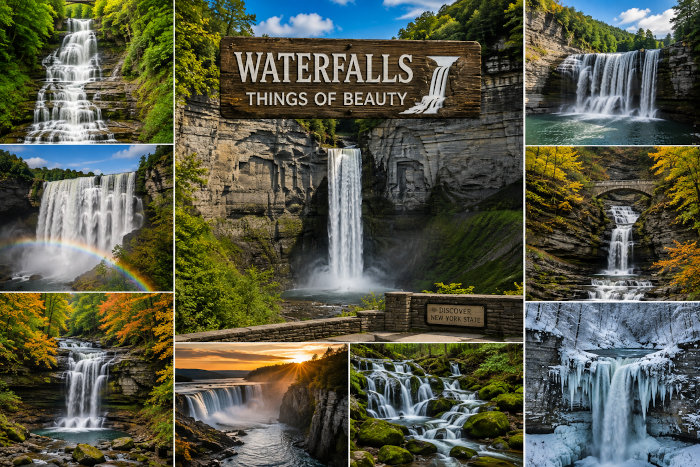
There is something about a waterfall that makes people stop.
We may have been hiking for miles.
Talking.
Thinking about something else.
Then we hear water ahead.
And suddenly we want to see it.
A waterfall can be enormous like Niagara.
Tall and narrow like Taughannock.
Hidden in a forest.
Spread across layers of rock.
Or simply a small stream dropping over a ledge after a heavy rain.
Whatever the size, waterfalls attract us.
They move.
They make sound.
They change with the seasons.
And unlike a mountain or cliff, a waterfall is never exactly the same twice.
New York State happens to be an especially good place to find them.
But why?
The answer involves glaciers, sedimentary rock, erosion, rivers and an enormous amount of time.
New York's waterfalls are beautiful because the landscape itself has a story.
First, You Need Water
A waterfall begins with an obvious ingredient.
Water.
New York has plenty of it.
Rain and snow feed thousands of streams and rivers.
The Great Lakes border the state.
The Finger Lakes fill deep glacial valleys.
Mountain streams drain the Adirondacks and Catskills.
Rivers such as the Genesee, Hudson, Delaware, Oswego and Niagara carry water across very different landscapes.
But water alone does not create a waterfall.
You also need a sudden change in elevation.
Gravity Does the Rest
Water always responds to gravity.
If a stream encounters a steep drop in the landscape, the water falls.
That sounds simple.
But what creates the drop?
Often the answer is geology.
Different kinds of rock erode at different rates.
A resistant layer may form a hard ledge while softer rock beneath it wears away more quickly.
The stream continues flowing.
The softer rock retreats.
The harder rock remains.
A waterfall develops.
Hard Rock Over Soft Rock
Many waterfalls exist because layers of rock behave differently.
Imagine a strong layer of limestone or sandstone sitting above softer shale.
The softer layer erodes faster.
Eventually the harder layer projects outward like a shelf.
Water pours over the edge.
As erosion continues beneath it, pieces of the harder rock may break away.
The waterfall gradually moves upstream.
The location changes.
The gorge behind it grows longer.
A waterfall is therefore not simply a feature sitting in the landscape.
It is part of an active process.
New York's Glacial Advantage
Then we add glaciers.
During the Ice Age, enormous continental glaciers repeatedly covered most of New York.
The most recent major ice sheets reshaped valleys, moved sediment, scraped bedrock and altered drainage systems.
The Finger Lakes are among the most dramatic results.
Glaciers deepened existing river valleys into long troughs.
When the ice eventually retreated, water filled those valleys.
But something interesting had happened to the smaller streams entering them.
The main valleys had been deepened much more dramatically than many of their tributary valleys.
That left some smaller streams essentially hanging above the newly deepened valley.
The water had to get down somehow.
It did what water does.
It fell.
Hanging Valleys
This helps explain why the Finger Lakes region contains so many gorges and waterfalls.
Streams that once joined larger valleys at similar elevations suddenly found themselves entering much deeper glacial valleys.
They began cutting downward.
Over thousands of years they carved narrow gorges through layers of sedimentary rock.
Where resistant layers slowed erosion, waterfalls formed.
So when you walk through a Finger Lakes gorge, you are seeing two geological processes working together.
Glaciers created the larger landscape.
Streams continued sculpting the details.
Watkins Glen State Park
Few places demonstrate this better than Watkins Glen.
Glen Creek flows through a narrow gorge cut deeply into layered rock.
Waterfalls appear one after another.
Stone stairways and trails allow visitors to walk beside the stream, across it and even behind portions of falling water.
What makes Watkins Glen remarkable is not one enormous waterfall.
It is the concentration.
Water.
Rock.
Narrow passages.
Cascades.
Plunge pools.
Layers.
Turns.
Every few minutes the gorge changes.
It almost feels designed.
But the designer was erosion.
Taughannock Falls
Not far away is one of New York's most dramatic waterfalls.
Taughannock Falls plunges approximately 215 feet into a huge natural amphitheater near Cayuga Lake.
It is taller than Niagara Falls in vertical drop, although Niagara carries vastly more water.
That comparison teaches something useful.
Height is only one way to describe a waterfall.
Volume matters.
Width matters.
Geology matters.
The shape of the gorge matters.
Each waterfall has its own character.
Tall Does Not Necessarily Mean Powerful
Taughannock can appear almost delicate during periods of lower flow.
A narrow ribbon of water drops from an enormous cliff.
Niagara is very different.
The scale of the river itself becomes part of the experience.
One waterfall impresses through height and setting.
The other overwhelms through volume and power.
Neither is better.
They demonstrate how many forms a waterfall can take.
Niagara Falls
No discussion of New York waterfalls can avoid Niagara.
It is one of the world's great natural landmarks.
The Niagara River carries water from Lake Erie toward Lake Ontario.
Along the way it crosses the Niagara Escarpment.
Water pours over resistant rock and into the gorge below.
The falls include American Falls, Bridal Veil Falls and Horseshoe Falls, with Horseshoe Falls extending across the international boundary between New York and Ontario.
But Niagara Falls has not always been where it is today.
Niagara Is Moving
As water erodes softer rock beneath harder caprock, sections collapse.
Over thousands of years, the waterfall has gradually retreated upstream, leaving the Niagara Gorge behind it.
Stand beside Niagara and it seems permanent.
Geologically, it is moving.
Again, our sense of time is simply different from the landscape's.
The Sound of Niagara
A photograph can show Niagara Falls.
It cannot completely reproduce being there.
The sound matters.
The mist matters.
The movement matters.
The huge volume of water continually disappearing over the edge makes the falls feel alive.
This is true of many waterfalls.
They are difficult to experience with only one sense.
Letchworth State Park
The Genesee River creates another extraordinary waterfall landscape at Letchworth State Park.
The river cuts through a deep gorge and passes over three major waterfalls known as Upper, Middle and Lower Falls.
The surrounding cliffs rise hundreds of feet above portions of the river.
Here the waterfall experience is not confined to one viewpoint.
The river, gorge, cliffs, forests and waterfalls combine into a much larger landscape.
Letchworth is sometimes called the “Grand Canyon of the East.”
But it is very much its own New York landscape.
One Park, Many Waterfalls
Letchworth contains far more than its three famous falls.
Seasonal streams descend the gorge walls, creating numerous smaller waterfalls after snowmelt and during wetter periods.
Some may disappear almost completely during dry weather.
This is another important lesson.
Waterfalls are seasonal.
The Same Waterfall Can Become a Different Waterfall
Visit a waterfall in April.
Then return in August.
Then visit again after several days of heavy rain.
You may feel as though you visited three different places.
Snowmelt can produce powerful spring flows.
Summer drought may reduce a waterfall to a narrow stream.
Heavy rain can transform a gentle cascade into turbulent water.
Winter can produce ice curtains, frozen spray and formations that temporarily change the shape of the falls.
The rock remains.
The waterfall changes.
Buttermilk Falls
Buttermilk Falls State Park near Ithaca presents another style of waterfall.
Water flows through a series of cascades and pools rather than simply making one enormous plunge.
The name itself reflects the appearance of foaming water moving over rock.
It reminds us that a waterfall does not need a single dramatic vertical drop to be beautiful.
Sometimes the appeal is a long sequence of falling water.
Robert H. Treman State Park
Nearby Robert H. Treman State Park contains another spectacular gorge system.
Enfield Creek descends through layered rock, creating waterfalls, cascades and pools.
Lucifer Falls is among the best-known features.
The Ithaca area is famous for gorges for a reason.
Glacial history, elevation changes, sedimentary rock and flowing water all come together in a remarkably small area.
Ithaca Is Gorges
The familiar phrase “Ithaca is Gorges” works because it is true.
Streams descend toward Cayuga Lake through steep terrain.
Along the way, they cut deeply into bedrock.
The result is an unusual concentration of gorges and waterfalls surrounding the city.
You can drive only a few miles and encounter another entirely different waterfall system.
Fillmore Glen
Fillmore Glen State Park near Moravia provides another excellent example.
A narrow wooded gorge contains a series of waterfalls and unusual rock formations.
The setting feels intimate compared with Niagara or Letchworth.
That is part of what makes exploring waterfalls so interesting.
Scale changes everything.
Chittenango Falls
Chittenango Falls in central New York drops over layers of bedrock in a broad, stepped formation.
The surrounding park allows visitors to see how a relatively modest stream can create a striking geological feature when the underlying rock provides the right conditions.
It is also a reminder that impressive waterfalls are not confined to the Finger Lakes.
Kaaterskill Falls
In the Catskills, Kaaterskill Falls has attracted visitors, artists and writers for generations.
The water drops in dramatic stages through the mountain landscape.
During the nineteenth century, scenes like Kaaterskill helped inspire the Hudson River School of landscape painting.
The waterfall became more than geology.
It became part of American art and ideas about wilderness.
Waterfalls and Art
This connection makes sense.
A waterfall naturally contains many things artists try to capture.
Motion.
Contrast.
Light.
Shadow.
Mist.
Rock.
Forest.
Reflections.
And depending on the season, color.
A waterfall gives the landscape a focal point.
Why Do We Find Falling Water Beautiful?
That is an interesting question.
Perhaps part of the answer is movement.
Most landscapes appear relatively still.
A mountain does not visibly change while we watch it.
A waterfall does.
Our eyes follow the water.
We watch individual patterns form and disappear.
The scene continually renews itself.
You cannot actually look at the same waterfall twice.
The water you saw a moment ago is already downstream.
The Sound Matters Too
Small waterfalls create gentle background noise.
Larger ones roar.
The sound can mask traffic and conversations.
It can make a place feel more isolated than it really is.
Even before we see a waterfall, hearing it creates anticipation.
Many hikes become more exciting the moment someone says:
“I can hear it.”
Mist Creates Its Own Environment
Falling water can produce mist and spray that change conditions around a waterfall.
Rock surfaces remain wet.
Mosses thrive.
Humidity increases.
Plants adapted to cool moist conditions may grow nearby.
In winter, spray freezes and creates ice even when the main flow remains open.
A waterfall can create a small local environment around itself.
Plunge Pools
At the base of many waterfalls is a deep pool.
This is not accidental.
Falling water carries energy.
It may also carry sand, gravel and stones.
Those materials strike the bottom and help erode the rock.
Over time, a plunge pool develops.
The water is essentially using sediment as tools.
Potholes in Rock
Moving water can also trap stones in depressions.
Currents rotate the stones repeatedly.
The stones grind against the bedrock.
Over time, surprisingly smooth circular potholes can form.
It is another example of how something as ordinary as a stone can become an effective erosion tool when water provides enough motion and enough time.
A Gorge Is a Waterfall's History
When a waterfall retreats upstream, it may leave a gorge behind.
That means a gorge can reveal where a waterfall used to be.
The waterfall we see today is simply the current position in a much longer process.
This is particularly dramatic at Niagara.
But the same basic principle operates at smaller waterfalls.
The gorge is history written in rock.
Waterfalls Reveal Rock Layers
Gorges also expose geology that would otherwise remain underground.
Instead of looking only at the surface, visitors can see layer after layer of sedimentary rock.
Some of those rocks were deposited hundreds of millions of years ago when environments in New York looked completely different.
Ancient seas once covered portions of the state.
Mud, sand and biological material accumulated.
Those sediments eventually became shale, sandstone and limestone.
Today, streams cut through them.
A waterfall can therefore expose a geological history vastly older than the waterfall itself.
Look for Fossils
Some exposed sedimentary rocks in New York contain fossils from ancient marine environments.
That can produce an almost strange realization.
You are standing beside a freshwater waterfall in New York State while looking at evidence of organisms that lived in an ancient sea hundreds of millions of years ago.
Landscapes change.
A lot.
Waterfalls and Mills
People did more than admire waterfalls.
They used them.
Before electricity became widely available, falling water represented power.
A stream dropping in elevation could turn a waterwheel.
That power could operate:
- Sawmills
- Gristmills
- Textile mills
- Machine shops
- Other early industries
Many New York communities developed around streams because moving water provided energy.
Beauty and Power
This created an interesting dual identity.
To one person, a waterfall was beautiful.
To another, it was horsepower.
A mill owner looked at falling water and saw useful energy.
An artist saw scenery.
A geologist saw erosion.
A hiker saw a destination.
The waterfall had not changed.
Only the observer had.
Hydroelectric Power
Eventually, falling and moving water became a source of electricity.
Niagara became one of the most famous locations associated with the development of large-scale hydroelectric power.
The principle is still familiar.
Water moves downhill.
Its energy turns turbines.
Turbines help generate electricity.
Gravity is doing part of the work.
Waterfalls in Winter
A New York waterfall in winter can be spectacular.
Icicles form along cliff walls.
Spray freezes.
Snow highlights rock layers.
Portions of smaller waterfalls may freeze nearly solid.
Larger waterfalls may continue flowing behind curtains of ice.
The transformation can make a familiar location seem completely new.
But winter also introduces serious hazards.
Waterfall Safety
Waterfalls invite exploration, but they deserve respect.
Wet rock is slippery.
Moss can be even more slippery.
Currents above a waterfall may appear calmer than they actually are.
Edges can be unstable.
Ice can hide hazards.
Flash flooding can dramatically change a stream.
Stay on designated trails and behind barriers.
Do not climb around fences for a better photograph.
And never assume shallow water above a waterfall is safe water.
The Most Dangerous Side May Be the Top
People naturally understand that standing below a large waterfall can be dangerous.
The top can sometimes appear deceptively peaceful.
Water may look shallow.
The edge seems close.
But once current carries a person toward the drop, there may be very little opportunity to recover.
Respect the water before it becomes the waterfall.
Photography and Waterfalls
Waterfalls are wonderful photography subjects because they change with light, weather and water level.
A cloudy day can reduce harsh contrast.
Early morning or evening light can add warmth.
Fall foliage creates color around white water.
Winter adds ice and snow.
After rainfall, increased flow can completely change the scene.
Even a phone camera can capture a memorable image if you first spend time looking at the composition.
Do Not Forget the Surroundings
It is tempting to point the camera directly at the waterfall and include nothing else.
Sometimes back up.
Include the gorge.
A tree.
A bridge.
A person for scale.
The stream continuing downstream.
The surroundings help tell the story of the waterfall.
Listen Before Taking the Picture
Sometimes we become so focused on photographing a destination that we barely experience it.
Take the picture.
Then put the camera down.
Listen.
Watch the water.
Look at the rock.
Notice the mist.
Feel the temperature change near the gorge.
The photograph should help you remember the experience.
It should not replace the experience.
Some Waterfalls Are Temporary
Not every waterfall appears on a map.
After spring snowmelt or prolonged rain, streams that normally carry very little water may suddenly descend cliffs and hillsides.
For a few days or weeks, waterfalls appear.
Then they disappear.
These seasonal falls can be some of the most rewarding to discover because they remind us how dynamic a watershed really is.
Go Back After Rain
If you have a favorite waterfall, visit it under different conditions.
After rain.
During dry summer weather.
During spring runoff.
In fall.
In winter where access is safe.
You will begin to understand that a waterfall is not one attraction.
It is many attractions occupying the same place.
Waterfalls Connect the Watershed
A waterfall is only one part of a stream.
The water began somewhere upstream.
Rain fell.
Snow melted.
Springs contributed groundwater.
Smaller tributaries joined together.
The water reached the falls.
Then continued downstream toward a larger creek, river, lake or ocean.
What happens throughout the watershed affects the waterfall.
Protecting the Water Protects the Falls
Water quality matters.
So does erosion upstream.
Development can alter runoff.
Vegetation helps stabilize stream banks.
Pollution entering water miles upstream may eventually pass directly over the waterfall we came to admire.
Protecting beautiful places often means protecting systems much larger than the scenic viewpoint.
A Waterfall Road Trip
New York offers enough waterfall diversity to build an entire trip around falling water.
Consider combining several different types:
- Niagara Falls: Experience enormous water volume and one of the world's great waterfall landscapes.
- Letchworth State Park: Explore the Genesee River gorge and its three major waterfalls.
- Taughannock Falls: See a dramatic 215-foot drop near Cayuga Lake.
- Watkins Glen: Walk through a narrow gorge filled with waterfalls and cascades.
- Robert H. Treman State Park: Explore Enfield Glen and Lucifer Falls.
- Buttermilk Falls: Discover a long series of cascades and pools near Ithaca.
- Fillmore Glen: Enjoy a wooded gorge and multiple smaller waterfalls.
- Chittenango Falls: Experience a broad central New York cascade.
- Kaaterskill Falls: Combine Catskill scenery with art and tourism history.
Before traveling, check current park information and trail conditions, particularly after storms or during winter and spring runoff.
Do Not Measure Beauty Only in Feet
It is easy to rank waterfalls.
Tallest.
Widest.
Most powerful.
Most famous.
But some of the most beautiful waterfalls may be only a few feet high.
A small forest stream dropping over moss-covered rock can be every bit as memorable as a famous destination.
Scale is impressive.
Setting creates beauty.
The Waterfall You Discover Yourself
There is something particularly enjoyable about hearing water while walking through the woods and then finding a waterfall you were not expecting.
It may not have a sign.
It may not have a name.
It may not appear in a travel guide.
But for that moment, it feels like your discovery.
New York contains countless small falls like this.
They are part of what makes exploring the state so rewarding.
Water Never Stops Working
Water looks soft.
Rock looks hard.
And yet given enough time, water wins.
It cuts gorges.
Moves stones.
Deepens pools.
Undercuts cliffs.
Moves waterfalls upstream.
And carries pieces of mountains toward the sea.
A waterfall allows us to watch geology happening.
Things of Beauty
Perhaps that is part of what makes waterfalls so appealing.
They combine permanence and change.
The cliff may be millions of years old.
The water lasts only a moment before moving downstream.
The gorge seems permanent.
Yet it is slowly becoming deeper and longer.
The waterfall looks as though it belongs exactly where it is.
Yet given enough time, it will move.
A waterfall is both a place and a process.
New York Written in Water
Our recent Discover New York State topics have looked at ways people altered the landscape.
We dug canals.
Built covered bridges.
Laid railroad tracks.
But waterfalls remind us that long before people began engineering New York, nature was already doing the work.
Glaciers carved enormous valleys.
Water found the new pathways.
Streams cut gorges.
Rock layers controlled where the water fell.
And the process continues today.
Every drop carries a tiny amount of the story forward.
The next time you stand beside a New York waterfall, enjoy the beauty.
Listen to it.
Photograph it.
Feel the mist.
But look at the rock too.
Look at the gorge behind it.
Think about the glacier that may have reshaped the valley.
Think about the stream slowly cutting backward through stone.
Then the waterfall becomes something more than scenery.
It becomes New York's geological history still happening right in front of us.