046 Railroads in New York State: The Tracks That Changed Everything
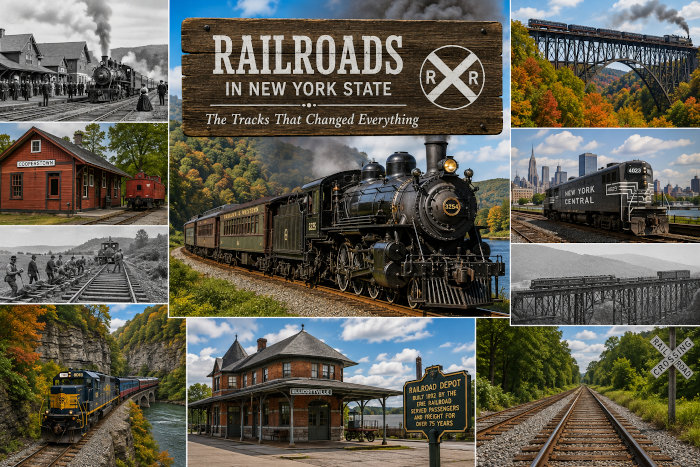
For a time, the Erie Canal seemed almost unbeatable.
It had dramatically lowered transportation costs.
It connected the Hudson River with the Great Lakes.
It helped towns become cities and helped New York become an economic powerhouse.
Then another transportation technology appeared.
The railroad.
Railroads did not need a continuous channel of water.
They could climb grades that canals could not.
They traveled faster.
They could operate during seasons when canals were closed by ice.
And tracks could eventually reach communities that had never benefited directly from canal transportation.
Once again, transportation changed New York.
Only this time, it happened on steel rails.
Before the Railroad
Before canals and railroads, moving people or freight over land could be slow, expensive and difficult.
Roads were often rough.
Mud could make travel miserable.
Snow created different problems.
Heavy loads required teams of horses.
Water transportation was usually more efficient, which explains why rivers, lakes and canals became so important.
But waterways determined where boats could go.
The railroad offered something revolutionary.
People could begin creating their own transportation corridors across the landscape.
A Simple Idea With Enormous Consequences
The basic concept seems simple.
Put smooth wheels on smooth rails.
Reduce friction.
Pull several cars together.
Suddenly one locomotive can move loads that would require enormous numbers of horses and wagons.
The principle allowed freight and passengers to move farther, faster and more predictably.
But making that simple idea work across hundreds of miles required remarkable engineering.
Building a Railroad
A railroad may look like two steel rails stretching into the distance.
But the rails are only the visible part of a much larger system.
Builders had to determine grades.
Cut through hills.
Fill valleys.
Build bridges.
Construct tunnels.
Drain water away from the roadbed.
Install ties.
Lay rail.
Build stations, maintenance facilities and yards.
And all of it had to be engineered so trains could move safely along a relatively smooth and predictable path.
Railroads Do Not Like Steep Hills
A train can pull enormous weight because steel wheels rolling on steel rails create relatively little resistance.
But that advantage comes with a limitation.
Steel wheels also have limited traction.
Railroads therefore prefer gradual grades.
When mountains or steep valleys stood in the way, railroad engineers had to become creative.
They built long sweeping curves.
Cut into hillsides.
Constructed massive embankments.
Built trestles across valleys.
And occasionally tunneled directly through mountains.
The path of an old railroad often tells you something about the landscape even if the tracks are gone.
The Railroad Comes to New York
Railroad development began in New York during the early nineteenth century while the Erie Canal was still relatively new.
At first, railroads were short individual lines connecting particular communities.
Over time, those lines grew, merged and connected.
By the middle of the nineteenth century, railroad networks were beginning to reshape transportation across the state.
The canal had created an east-west transportation revolution.
The railroad expanded that revolution in almost every direction.
Albany to Schenectady
One of New York's earliest important railroads connected Albany and Schenectady.
That may seem like a relatively short distance today.
But the route demonstrated an important idea.
Rail transportation could compete with established roads and waterways.
The early railroad era was filled with experimentation.
Locomotives changed rapidly.
Track construction improved.
Braking systems improved.
Passenger cars became more comfortable.
What began as something experimental quickly became something essential.
The New York Central
Eventually, several smaller lines across upstate New York became part of the New York Central system.
The railroad followed a natural transportation corridor through the Hudson and Mohawk valleys and across central and western New York.
That should sound familiar.
The Erie Canal had followed much of the same geographic logic.
Good transportation routes tend to remain good transportation routes.
Rivers, canals, railroads, highways and modern utilities often occupy similar corridors because the landscape itself influences where movement is easiest.
The Water-Level Route
The New York Central became famous for what was often described as its “Water Level Route.”
By following the Hudson River valley and Mohawk Valley, trains could cross New York without confronting the steep mountain grades found on many other railroad routes.
This reduced the amount of climbing locomotives had to do and made the corridor extremely efficient.
Once again, New York's geography became an economic advantage.
The Erie Railroad
Another major railroad crossed southern New York.
The Erie Railroad connected the New York metropolitan region with communities across the Southern Tier and ultimately Lake Erie.
Its route helped communities such as Port Jervis, Binghamton, Elmira, Corning and others participate in expanding railroad commerce.
Where the New York Central largely followed the central corridor, the Erie opened another major path across the state.
Railroads were beginning to knit New York together.
Railroads Created Towns
Transportation influences where communities grow.
A station could change the future of a village.
Farmers suddenly had easier access to distant markets.
Manufacturers could receive raw materials and ship finished products.
Hotels appeared near depots.
Stores opened.
Warehouses were constructed.
Workers arrived.
A place that had once been relatively isolated could become connected with cities hundreds of miles away.
And Railroads Could Bypass Towns
The opposite was also true.
If a railroad chose a different route, an established community could find itself left behind.
Transportation creates winners and losers.
The Erie Canal had already demonstrated this.
Railroads repeated the lesson.
A few miles could make an enormous difference.
The Depot Became the Front Door
Before widespread automobile travel, the railroad station was often the front door of a community.
Visitors arrived there.
Mail arrived there.
Newspapers arrived there.
Products arrived there.
Residents departed from there.
A well-designed station was more than a transportation building.
It represented the town.
Many New York communities still contain old depots long after regular passenger service disappeared.
Some have become museums.
Some are restaurants.
Some became offices.
Others sit quietly beside tracks that are rarely used.
But their locations tell you where the center of activity once was.
Railroad Time
Railroads even changed the way people thought about time.
Before rapid transportation, individual communities could rely more heavily on local solar time.
That worked reasonably well when travel was slow.
It became a problem when trains needed precise schedules across long distances.
Railroads helped drive the adoption of standardized time zones.
A train could not operate efficiently if every town's clock meant something slightly different.
Transportation was beginning to synchronize society.
Moving New York's Farm Products
Railroads transformed agriculture.
A farmer no longer had to rely only on nearby markets.
Milk could travel to cities.
Fruit could travel farther before spoiling.
Livestock could be transported in specialized rail cars.
Grain and feed moved in bulk.
Fertilizer and equipment could arrive from distant manufacturers.
The railroad expanded both the market available to farmers and the resources available to farms.
The Milk Train
For generations of rural New Yorkers, the railroad was closely tied to dairy farming.
Milk trains collected cans and later refrigerated shipments from communities throughout the countryside and carried them toward population centers.
That connection between farm and city helped make large-scale dairy markets possible.
An ordinary train passing through a rural station could therefore be part of someone's morning milking routine hundreds of miles away.
Moving Lumber and Stone
Railroads were equally important to New York's natural-resource industries.
Lumber could move out of forest regions.
Quarried stone could travel to cities and construction projects.
Coal arrived from mining regions outside the state.
Iron, machinery and manufactured products traveled in the opposite direction.
The railroad connected local resources with distant demand.
Railroads and the Adirondacks
Railroads dramatically changed access to the Adirondacks.
Before rail transportation, reaching remote parts of northern New York could require difficult travel by wagon, boat or foot.
Railroads shortened the journey.
Tourists arrived.
Hotels developed.
Sportsmen traveled north to fish and hunt.
Vacationers discovered mountain communities.
At the same time, railroads supported logging and other industries that were changing the Adirondack landscape.
The railroad brought both recreation and resource extraction.
The Railroad Helped Create Tourism
We often think of tourism as a modern industry built around automobiles and airplanes.
Railroads were creating destination tourism long before either became common.
Railroad companies actively promoted scenic destinations.
They produced brochures.
Advertised hotels.
Promoted resorts.
And helped convince city residents that the mountains, lakes and countryside were places worth visiting.
Transportation companies discovered an important business principle:
If you own the way to get somewhere, it helps to give people a reason to go.
Grand Central Terminal
Railroad history in New York is not limited to rural tracks and small depots.
At the opposite extreme stands Grand Central Terminal in New York City.
Its enormous main concourse, architecture and elaborate details demonstrate just how important railroad travel once was.
A railroad terminal could be monumental.
It could announce that transportation itself mattered.
Millions of travelers moved through buildings designed to make arrival and departure feel important.
Pennsylvania Station
New York City's original Pennsylvania Station offered another magnificent entrance to the city.
Its eventual demolition in the 1960s became one of the defining moments of the American historic-preservation movement.
The loss demonstrated that even enormous and seemingly permanent landmarks could disappear when people stopped valuing them.
Sometimes preservation movements begin because something important is lost.
The Railroad Bridge
Railroads required extraordinary bridges.
A railroad bridge must carry enormous concentrated loads while remaining rigid enough to keep tracks aligned.
Wooden trestles were common during earlier periods.
Iron and steel eventually allowed much larger spans.
Stone arches carried tracks across streams.
Massive viaducts crossed valleys.
Some of these structures survive even after the railroad itself disappeared.
The Poughkeepsie Railroad Bridge
One of the most dramatic examples crosses the Hudson River at Poughkeepsie.
The enormous railroad bridge once carried trains high above the Hudson.
After railroad service ended, the structure could easily have become an abandoned industrial relic.
Instead, it found another life.
Today it is Walkway Over the Hudson State Historic Park.
People walk and bicycle where freight and passenger trains once traveled.
The bridge still connects two sides of the Hudson.
Only the traffic has changed.
Another Example of Reinvention
This should sound familiar.
The Erie Canal towpath became recreational trail.
Covered bridges became historic destinations.
And old railroad corridors are increasingly becoming trails.
Infrastructure can outlive its original purpose.
The fact that trains no longer use a route does not mean the route has lost all value.
Why Railroads Make Great Trails
Former railroad corridors have several characteristics that make them particularly suitable for walking and bicycling.
Railroads generally require gradual grades.
The routes are relatively direct.
Bridges and cuts already carry the corridor across difficult terrain.
The right-of-way may pass through forests, farms, towns and river valleys.
Remove the rails and ties, improve the surface, and an old transportation corridor can become a recreational corridor.
The engineering work performed a century earlier is still useful.
Rail Trails Across New York
New York now contains many former railroad corridors converted to public trails.
The Hudson Valley Rail Trail, Wallkill Valley Rail Trail, William R. Steinhaus Dutchess Rail Trail and numerous other routes allow people to experience landscapes once seen from train windows.
Some of these trails now form sections of the statewide Empire State Trail.
The traffic has changed from locomotives to bicycles, walkers and runners.
But people are still traveling the corridor.
Look for Railroad Clues
When walking a rail trail, look beyond the trail surface.
You may notice:
- Old mile markers
- Telegraph poles
- Stone bridge abutments
- Former station foundations
- Railroad bridges and trestles
- Long straight cuts through hills
- Embankments across wetlands
- Old sidings or industrial foundations
- Occasional sections of abandoned rail
The trail is not simply passing through history.
The trail itself is history.
Rails With Trails
Not every recreational trail replaces an abandoned railroad.
In some locations, trails operate near active tracks.
These “rails with trails” allow recreation and modern rail transportation to occupy portions of the same corridor.
They also provide an interesting reminder that railroads are not merely historical.
Freight rail remains an important part of New York's transportation network.
Freight Trains Still Matter
Passenger trains may attract more public attention, but freight rail continues doing enormous amounts of work.
One freight train can move a tremendous amount of material.
Railroads transport automobiles.
Construction materials.
Food products.
Chemicals.
Containers.
Lumber.
Paper.
And many other commodities.
The modern freight train is a direct descendant of the transportation revolution that began nearly two centuries ago.
Passenger Rail Still Matters Too
New York remains one of the nation's most important passenger-rail states.
Amtrak trains connect New York City with Albany, Buffalo, Niagara Falls and communities across central and western New York.
Other routes connect with the Adirondacks, Canada and neighboring states.
Commuter railroads move enormous numbers of people through the New York metropolitan region every day.
The railroad did not disappear when automobiles arrived.
Its role changed.
Railroad Museums
Historic railroad equipment provides another way to understand the scale of this technology.
A locomotive viewed from a photograph can look impressive.
Stand beside one and it becomes something else entirely.
The wheels alone may be taller than a person.
Rods, valves, boilers, motors and mechanical systems reveal just how complicated railroad technology became.
New York contains numerous railroad museums, preserved stations and historical organizations that keep this history alive.
Ride the History
One particularly enjoyable way to experience railroad history is to ride a heritage or scenic railroad.
Instead of viewing the locomotive behind a fence, passengers can experience the motion, sound and landscape from aboard the train.
Several New York railroads continue offering scenic and special-event excursions.
The Adirondack Railroad operates excursions through portions of central and northern New York, including routes from Utica, Thendara and Tupper Lake.
The Catskill Mountain Railroad offers heritage train rides from Kingston through portions of the Catskills.
Schedules and routes can change, so always check directly with the railroad before planning a trip.
Why Do We Still Love Trains?
There is something about a train that continues attracting attention.
A child hears a whistle and turns toward it.
Adults stop at railroad crossings and watch cars pass.
Model railroads remain popular.
Historic locomotives draw crowds.
Perhaps part of the fascination is scale.
A locomotive is a huge machine doing something easy to understand.
It is pulling.
And it is pulling an astonishing amount of weight.
The Sound of the Railroad
Railroads created their own soundscape.
The whistle.
The bell.
The rhythm of wheels crossing rail joints.
The mechanical sounds of a steam locomotive.
Brakes.
Couplers.
The low rumble of a freight train approaching in the distance.
For generations of New Yorkers living near tracks, those sounds were part of everyday life.
Steam Changed Everything
Steam locomotives were among the most visible machines of the industrial age.
Coal or wood produced heat.
Heat boiled water.
Steam pressure moved pistons.
Connecting rods turned driving wheels.
Fire became motion.
The system required constant attention from engineers and firemen, along with enormous maintenance infrastructure.
Steam locomotives were powerful, dramatic and labor intensive.
Then Diesel Changed the Railroad
Diesel-electric locomotives gradually replaced steam during the twentieth century.
They required less servicing.
They could operate for longer periods without stopping for water.
Multiple locomotives could be controlled together.
Railroads eliminated much of the enormous support network needed to maintain steam locomotives.
Once again, technology changed transportation.
When the Railroad Leaves Town
Railroad abandonment can dramatically change a community.
A depot closes.
The tracks become rusty.
Industries lose rail service.
Eventually rails may be removed.
Vegetation begins reclaiming the corridor.
Within surprisingly few years, a transportation route that once seemed permanent can nearly disappear.
Yet the shape of the land often remains.
Finding an Abandoned Railroad
Old railroad corridors can sometimes be recognized even decades after the rails disappear.
Look for an unusually straight raised path through a wet area.
A deep narrow cut through a hillside.
A stone culvert beneath what appears to be a forest path.
Large bridge abutments facing each other across a creek.
A long level bench carved into a slope.
Once you learn the shape of railroad engineering, abandoned lines become easier to recognize.
Transportation Layers
Some of the most interesting New York landscapes contain several generations of transportation close together.
A river may have been the first route.
A canal followed.
Then a railroad.
Then a highway.
Today, a recreational trail may follow one of the older corridors.
Stand in the right location and you can sometimes see several centuries of transportation history at once.
The Canal and Railroad Were Competitors
Railroads eventually took much of the freight and passenger business once dominated by canals.
But the relationship was more complicated than one simply replacing the other.
Both systems continued operating.
Both moved enormous amounts of material.
Both were improved.
And both influenced where later highways and industries developed.
Transportation systems rarely disappear overnight.
They overlap.
The Automobile Changes Things Again
Then came another major competitor.
The automobile.
Cars offered individual freedom.
Trucks could deliver freight directly from one location to another without transferring it between railroad station and final destination.
Roads improved.
Highways expanded.
Air travel changed long-distance passenger transportation.
Many passenger trains disappeared.
Branch lines were abandoned.
Railroad companies consolidated.
Again, transportation reinvented itself.
Old Infrastructure, New Life
This has become a recurring theme in our exploration of New York.
The Erie Canal was built for freight and now attracts boaters, bicyclists and walkers.
Covered bridges were built for everyday transportation and are now historic destinations.
Railroads built bridges, grades and corridors that in some places now carry entirely different kinds of travelers.
A cyclist crosses the Hudson on a railroad bridge.
A walker follows an old rail bed through the woods.
A family boards a heritage train simply for the enjoyment of the ride.
The infrastructure survived because somebody discovered another use for it.
Planning a Railroad-Themed New York Trip
Railroad history can be incorporated into almost any New York trip.
- Visit a historic depot: Many communities have preserved stations as museums or public buildings.
- Ride a heritage railroad: Experience rail travel through the Adirondacks or Catskills.
- Walk a rail trail: Follow an old railroad grade and look for surviving engineering features.
- Cross Walkway Over the Hudson: Experience one of New York's great railroad bridges on foot or bicycle.
- Visit Grand Central Terminal: See railroad architecture on an entirely different scale.
- Explore a railroad museum: Examine locomotives, cars, tools and artifacts up close.
- Watch modern freight trains: Remember that railroad transportation remains very much alive.
Look Beyond the Train
The train itself is fascinating.
But when exploring railroad history, look at everything around it.
The station.
The bridge.
The cut through the hill.
The warehouse positioned beside the tracks.
The factory siding.
The town street that points toward the depot.
The hotel built near the station.
The old rail bed now carrying bicycles.
A railroad is not merely a train.
It is an entire transportation landscape.
The Tracks That Changed Everything
The Erie Canal taught New York what improved transportation could accomplish.
The railroad took that lesson and accelerated it.
Distances became shorter in practical terms.
Markets became larger.
Towns became connected.
Tourists reached the mountains.
Farm products reached cities.
Factories received materials.
News and mail moved faster.
People began expecting travel to happen according to a schedule.
Railroads changed not only where New Yorkers could go.
They changed how New Yorkers thought about distance and time.
Still Following the Rails
Today, some tracks still carry freight.
Others carry commuters and long-distance passengers.
Some carry heritage trains filled with people who boarded simply because riding a train is fun.
And some tracks are gone completely.
Yet even those abandoned corridors continue influencing New York.
They have become trails.
Parks.
Historic landmarks.
And clues to understanding why towns and industries developed where they did.
The rails may disappear.
The influence remains.
That may be one of the most remarkable things about transportation infrastructure.
Long after we stop using it exactly as its builders intended, it can continue shaping our lives.
The railroad connected New York with steel rails. Nearly two centuries later, we are still following the paths those rails created.