045 Caves of New York State: Discovering the World Beneath Our Feet
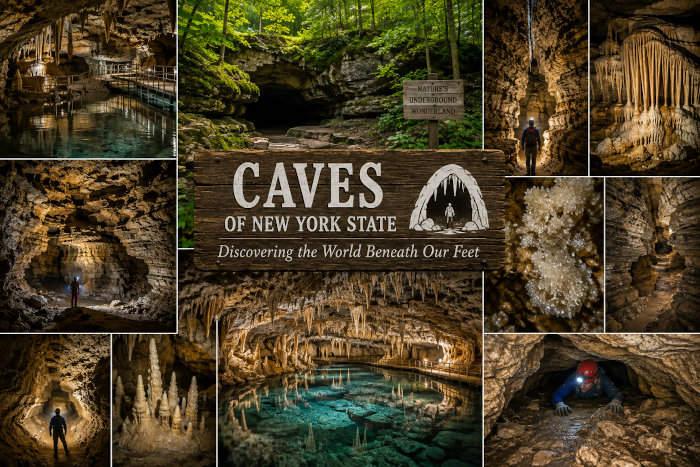
New York has mountains.
Waterfalls.
Lakes.
Rivers.
Forests.
And another landscape that most of us rarely see.
The one beneath our feet.
Across portions of New York State, water has spent thousands and sometimes millions of years working its way through rock, widening cracks, creating passages and forming underground rooms.
The result is a hidden landscape of caves, caverns, underground streams and unusual mineral formations.
Some caves are small.
Others contain large chambers and extensive passageways.
Some can be comfortably explored on a guided walking tour.
Others should only be entered by experienced and properly equipped cave explorers.
But they all begin with the same fascinating combination:
Rock, water and time.
A Hot Day and a Cool Cave
If you have ever visited Howe Caverns on a hot summer day, one of the first things you may remember is the temperature.
You leave the warm summer air, travel underground and suddenly it feels as though someone turned on a giant natural air conditioner.
Except nobody did.
Deep underground, temperatures remain much more stable than they do at the surface.
The ground acts as an enormous thermal buffer.
Summer heat does not penetrate deeply enough to warm a cave the way it warms the surface.
Winter cold has the same limitation.
As a result, deeper caves often remain near the average annual temperature of their region throughout the year.
On a hot day, that feels wonderfully refreshing.
On a cold winter day, the same cave may actually feel relatively warm.
How Do Caves Form?
Many of New York's best-known caves occur in limestone.
Limestone is largely composed of calcium carbonate.
Rainwater absorbs carbon dioxide from the atmosphere and especially from soil as it moves underground.
This creates a weak carbonic acid.
The water is not dramatically acidic.
You would not see it eating through rock before your eyes.
But geology has something we do not.
Time.
Slightly acidic groundwater enters cracks and fractures in limestone and slowly dissolves the rock.
A tiny crack becomes wider.
More water can enter.
The opening grows.
Given enough time, a fracture can become a passage.
A passage can become a tunnel.
And a tunnel can open into a cavern.
Water Is the Builder
We often think of caves as empty spaces carved out of rock.
But perhaps it is better to think of them as evidence of moving water.
Water follows gravity.
It finds weaknesses.
It enters joints and fractures.
It dissolves soluble rock.
It carries sediment.
It changes course as underground drainage systems evolve.
Some cave passages that are dry today were once active underground streams.
Other caves still contain flowing water.
The cave is the record left behind.
Karst Landscapes
Areas where soluble rock such as limestone has been shaped by groundwater are often described as karst landscapes.
Karst does not exist only underground.
Surface clues may include:
- Sinkholes
- Springs
- Streams that suddenly disappear underground
- Streams that emerge unexpectedly from rock
- Depressions with no obvious surface drainage
- Caves and underground channels
Once you understand karst, the surface landscape starts making more sense.
The water may not be missing.
It may simply be traveling somewhere you cannot see.
Where Are New York's Caves?
Caves are not distributed evenly across New York.
The underlying geology determines where significant solution caves are likely to develop.
Regions containing appropriate limestone and other soluble rocks provide the best conditions.
Parts of eastern and central New York contain particularly important cave areas.
Schoharie County is probably the best-known example because it contains both Howe Caverns and Secret Caverns as well as numerous wild caves.
But caves and karst features occur in other portions of the state as well.
Howe Caverns
Howe Caverns is probably New York's best-known cave attraction.
Located near Howes Cave in Schoharie County, it provides visitors with an opportunity to travel deep underground without becoming technical cave explorers.
Guided tours introduce visitors to underground passages, rock formations and flowing water while providing developed walkways and lighting.
For many New Yorkers, Howe Caverns is their first real experience inside a cave.
And that first experience can change the way you think about the ground beneath you.
Standing inside a large underground chamber creates an obvious question:
How did all of this get here?
Lester Howe and a Cow
The history of Howe Caverns includes one of those stories that seems almost too perfect.
In the nineteenth century, farmer Lester Howe noticed that his cows repeatedly gathered near a particular area during hot weather.
Why?
Cool air was emerging from an opening in the ground.
Following that clue eventually led Howe to explore the cave system that would carry his name.
Think about how wonderfully simple that observation was.
The cows did not understand cave geology.
They simply knew where it felt good on a hot day.
Sometimes discovery begins by noticing something unusual and asking why.
That Cool Air Tells a Story
The cool air emerging from a cave entrance is not merely refreshing.
It is evidence of a much larger underground environment.
Air moves because of temperature and pressure differences between the cave and surface.
Seasonal changes can alter the direction and strength of cave airflow.
Experienced cave explorers sometimes use airflow as a clue that additional passages may exist beyond an opening.
A small crack breathing cool air can hint at a much larger void hidden behind the rock.
Secret Caverns
Not far from Howe Caverns is another very different underground attraction: Secret Caverns.
Its best-known feature is an underground waterfall.
The proximity of these two attractions demonstrates something important about the Schoharie Valley.
Howe Caverns is not simply an isolated hole in otherwise ordinary rock.
It is part of a region whose geology allows extensive underground drainage and cave development.
There is an entire hidden landscape beneath portions of the area.
Stalactites and Stalagmites
Caves are not only created by dissolving rock.
Water can also build formations.
As mineral-rich water enters an air-filled cave, conditions change.
Carbon dioxide may escape from the water, allowing dissolved calcium carbonate to precipitate.
Drop by drop, tiny amounts of mineral are deposited.
Over very long periods of time, those deposits can create remarkable formations.
Stalactites grow downward from ceilings.
Stalagmites grow upward from floors.
When they eventually meet, they can form a column.
Other formations may resemble curtains, ribbons, flowstone or frozen waterfalls.
Remembering Which Is Which
There is an old memory trick:
Stalactites hold tight to the ceiling.
Stalagmites might someday reach the ceiling.
It may not be sophisticated geology.
But it works.
Why You Should Not Touch Cave Formations
A cave formation may have taken hundreds or thousands of years to develop.
Touching it can leave oils and dirt from human skin on the surface.
That contamination can interfere with future mineral deposition and permanently alter delicate formations.
Something that took nature centuries to create can be damaged in seconds.
That is why responsible cave tours emphasize a simple rule:
Look, but do not touch.
Caves Are Still Changing
A cave may look permanent.
It is not.
Water continues moving.
Minerals continue dissolving.
Other minerals continue being deposited.
Sediment moves.
Rock occasionally falls.
Streams change course.
The process is simply happening on a timescale much slower than our own.
When you enter a cave, you are entering a landscape still under construction.
Show Caves and Wild Caves
There is a tremendous difference between visiting a developed show cave and exploring a wild cave.
A show cave may provide:
- Guides
- Lighting
- Walkways
- Stairs
- Railings
- Established routes
- Emergency procedures
That allows people with little or no cave experience to safely see an underground environment.
A wild cave may provide none of those things.
No lights.
No signs.
No paved path.
No railing.
No convenient exit.
And possibly no cellular service.
Wild Caving Is a Different Activity
Exploring undeveloped caves can involve crawling, climbing, mud, water, tight passages, unstable surfaces and complicated navigation.
Flooding can occur.
Hypothermia is possible even when surface weather is warm.
A failed flashlight underground is far more serious than a failed flashlight on a hiking trail.
People interested in wild caving should learn from experienced cavers, obtain permission where required, use proper equipment and never enter caves casually or alone.
The fact that a hole is accessible does not mean it is safe to explore.
Three Sources of Light
Experienced cave explorers traditionally follow an important rule:
Carry multiple independent sources of light.
A headlamp may be your primary light.
But batteries fail.
Lights break.
Equipment gets wet.
Underground darkness is complete darkness.
Having backup lighting is not simply convenient.
It can be essential.
Water Can Change Everything
Because caves often form around underground drainage, rain at the surface can create hazards underground.
A passage that is easily crossed under normal conditions may become dangerous after heavy rainfall.
Water levels can rise.
Currents can strengthen.
Low passages can flood.
And the rain responsible for those changes may have fallen somewhere other than directly above the cave entrance.
Understanding weather and drainage is therefore part of responsible cave exploration.
Bats and New York Caves
Caves provide important habitat for several bat species.
Some bats use caves as winter hibernation sites because underground temperatures remain relatively stable.
During hibernation, bats survive on stored energy reserves.
Repeated disturbance can force them to wake and use energy they need to survive the winter.
This is one reason seasonal cave closures should always be respected.
White-Nose Syndrome
New York has played a significant role in another modern cave story.
White-nose syndrome, a devastating disease affecting hibernating bats, was first documented in New York in the mid-2000s.
The disease is associated with a fungus that grows in cool underground environments.
It has caused enormous declines in several North American bat populations.
Today, cave conservation includes not only protecting rock formations but also protecting the animals that depend upon caves.
Visitors should follow current guidance regarding cave closures, equipment cleaning and decontamination.
A Cave Is an Ecosystem
At first glance, caves may seem almost lifeless.
There is little or no sunlight.
Plants cannot grow in the normal way.
Food can be scarce.
Yet caves contain ecosystems adapted to those unusual conditions.
Bats may use caves seasonally.
Invertebrates may live in damp passages.
Microorganisms occupy environments we are only beginning to understand.
Organic material may enter through water, animals or cave entrances.
Life finds ways to occupy even this dark environment.
Groundwater We Cannot See
Caves also teach us an important lesson about groundwater.
Water underground does not always move slowly and evenly through soil like water through a sponge.
In karst areas, water can travel rapidly through cracks, conduits and cave passages.
That means contaminants introduced at the surface may travel surprisingly quickly underground.
A sinkhole can essentially provide a shortcut into groundwater.
Protecting karst landscapes therefore has implications far beyond protecting caves.
It can also mean protecting drinking water.
Caves as Geological Time Capsules
Caves can preserve evidence that disappears quickly at the surface.
Sediments may contain information about earlier environments.
Mineral deposits can preserve chemical records of past climate conditions.
Animal remains can reveal species that once lived in an area.
Archaeological material may preserve evidence of human activity.
A cave can therefore function as more than a hole in the ground.
It can be an archive.
The Landscape Above and Below
One of the most interesting things about caves is that they force us to think in three dimensions.
When we look at a map, we normally see roads, rivers, hills and towns.
But beneath some landscapes is another drainage network entirely.
A stream may disappear underground.
Travel through rock.
Join another underground channel.
And emerge miles away as a spring.
The landscape we see is only part of the system.
Why Caves Feel So Different
A cave changes several things we normally use to understand our surroundings.
There is no horizon.
No sky.
No sunlight.
No obvious sense of weather.
Sounds echo differently.
Distances can be difficult to judge.
And without artificial light, vision disappears completely.
That makes even a comfortable guided cave tour feel like entering another world.
In a sense, you are.
Natural Air Conditioning
And then there is that temperature.
On a hot New York summer day, stepping underground can be wonderfully refreshing.
It feels almost impossible that such cool air exists only a short distance below the heat.
But the cave has not suddenly cooled for your visit.
It has been waiting at roughly the same temperature all along.
We experience the dramatic change because the surface changes so much more.
Nature created a remarkably stable environment without a thermostat, compressor or electric bill.
Planning a New York Cave Adventure
For most visitors, a developed cave is the ideal introduction to New York's underground landscape.
Consider:
- Howe Caverns: New York's best-known commercial cavern and an excellent introduction to cave geology.
- Secret Caverns: A different underground experience nearby, including its well-known underground waterfall.
- Karst landscapes: Even without entering a cave, look for springs, disappearing streams, sinkholes and limestone terrain.
- Wild caves: Explore only with appropriate experience, permission, equipment and awareness of current conservation restrictions.
Always check current hours, tour availability and access rules before traveling.
Protect What Took So Long to Create
Caves operate on geological time.
A formation growing a fraction of an inch over many years does not recover quickly from damage.
A bat population affected by disturbance or disease may require decades to recover.
A groundwater system contaminated through a sinkhole can affect areas far beyond the point where pollution entered.
Responsible cave exploration therefore begins with respect.
Do not damage formations.
Do not leave trash.
Do not disturb wildlife.
Respect closures and private property.
And leave underground places as you found them.
Discovering Another New York
We usually discover New York by looking outward.
Across an Adirondack mountain.
Over a Finger Lakes valley.
Down into a gorge.
Across Lake Ontario.
At a waterfall.
But caves ask us to look somewhere different.
Down.
Beneath farms, forests and roads is another landscape shaped by the same forces that created so much of the New York we see above ground.
Water.
Rock.
Gravity.
Time.
Visit a cave and you begin to understand that the ground beneath your feet is not necessarily solid and unchanging.
It may contain passages.
Streams.
Rooms.
Wildlife.
And a geological story that began long before any of us arrived.
On a hot summer day, you might first enter because the cave feels wonderfully cool.
But if you pay attention, you come back out seeing the landscape a little differently.
Sometimes discovering New York means discovering the New York we cannot see.