048 Birding in New York State: Look Up, Listen, and Discover
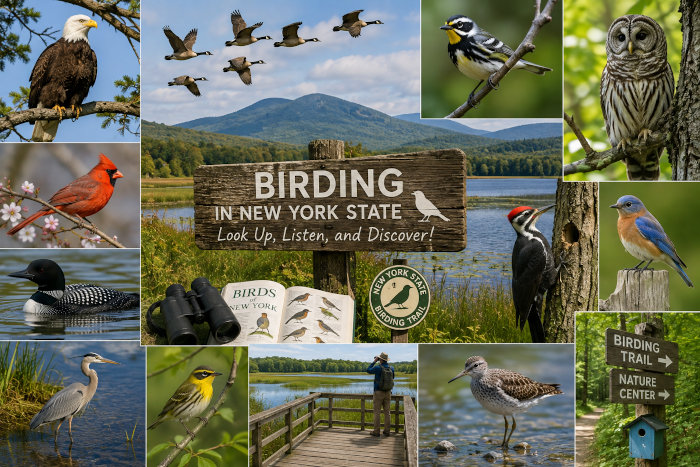
You do not need a boat.
You do not need a mountain.
You do not need expensive equipment.
You do not even need to travel very far.
Sometimes discovering New York State begins by simply stopping, looking up and listening.
A chickadee calls from a tree.
A great blue heron lifts slowly from a marsh.
A bald eagle circles over a river.
Thousands of geese fill the sky during migration.
A tiny warbler arrives after traveling hundreds or even thousands of miles.
And suddenly an ordinary walk becomes something more.
You are birding.
Birding Can Begin Anywhere
One of the wonderful things about birding is how little you need to begin.
You can watch birds from a backyard.
A city park.
A farm field.
A lake.
A hiking trail.
A beach.
A wetland.
Or even through a kitchen window.
You do not need to identify every bird.
You do not need a checklist.
You do not need binoculars.
Those things can make birding more interesting, but curiosity is really the only requirement.
Why New York Is So Good for Birding
New York contains an extraordinary variety of habitats.
Atlantic coastline.
Great Lakes shoreline.
Finger Lakes.
Adirondack mountains.
Catskill forests.
Grasslands.
Marshes.
Rivers.
Farm country.
Urban parks.
Each habitat supports a different combination of birds.
Move across New York and the bird community changes with the landscape.
More Than 450 Species
More than 450 different bird species have been observed in New York State.
Some live here throughout the year.
Some arrive for summer.
Some spend only the winter.
And others simply pass through during migration.
That means birding is never really finished.
The birds you see in May may be completely different from the birds occupying the same location in January.
Migration Changes Everything
Spring and fall are particularly exciting times for New York birders.
Millions of birds are moving between breeding and wintering areas.
Some travel during the day.
Many songbirds migrate primarily at night.
They may fly hundreds of miles and then descend into forests, parks and wetlands to rest and feed.
A quiet patch of woods that seemed almost empty yesterday can suddenly be filled with birds.
Then a few days later, many of them are gone.
The Atlantic Flyway
New York lies along the Atlantic Flyway, one of the major migration corridors used by birds traveling through eastern North America.
But a flyway is not a highway with clearly marked lanes.
It is a broad geographic corridor.
Coastlines, rivers, lakes, mountain ridges and wetlands can all help influence where birds travel and where they stop.
This makes New York especially important during migration.
Rest Stops for Birds
Think about a bird migrating hundreds or thousands of miles.
It needs places to stop.
Food.
Water.
Shelter.
Protection from predators.
A wetland or forest patch may therefore be much more than an attractive natural area.
For a migrating bird, it can be a refueling station.
Lose too many of those stopping places and the journey becomes much more difficult.
Montezuma National Wildlife Refuge
One of New York's great birding destinations is Montezuma National Wildlife Refuge at the northern end of Cayuga Lake.
The refuge contains extensive wetlands that provide feeding, resting and nesting habitat for enormous numbers of birds.
During migration, waterfowl can gather in spectacular numbers.
Geese.
Ducks.
Shorebirds.
Herons.
Egrets.
Raptors.
Warblers.
And many others use the larger Montezuma Wetlands Complex.
It is a wonderful example of what happens when water, habitat and migration routes come together.
Montezuma and Bald Eagles
Montezuma also played an important role in the return of bald eagles to New York.
During the 1970s, bald eagle populations had declined dramatically.
Montezuma became the location of New York's first bald eagle restoration program.
Young eagles were raised and released into the wild.
Today, seeing a bald eagle in New York is no longer the extraordinary rarity it once was.
That is one of the state's great wildlife conservation success stories.
The Return of the Bald Eagle
There is something special about seeing a bald eagle in the wild.
The white head and tail of an adult are unmistakable.
But younger bald eagles look very different.
They are mostly dark brown and gradually develop the familiar adult plumage over several years.
That means a large dark bird near a river may still be a bald eagle even without the famous white head.
Look Near Water
Bald eagles are often associated with rivers, lakes and reservoirs because fish make up an important part of their diet.
Look for large birds perched in tall trees overlooking water.
Also watch the sky.
An eagle soaring high overhead can initially look like little more than a dark shape.
Learning the silhouette becomes part of birding.
New York's Great Blue Heron
Few New York birds look more prehistoric than a great blue heron taking flight.
Standing still beside water, it can seem almost like part of the landscape.
Then enormous wings unfold.
The long neck folds backward.
Long legs trail behind.
And the bird slowly lifts away.
Great blue herons can be found around wetlands, rivers, ponds and lake edges throughout much of New York.
Watch the Edges
Birding teaches you to pay attention to edges.
The edge between forest and field.
The edge of a marsh.
The shoreline of a lake.
The boundary between shrubs and open grass.
Edges often bring different habitats together.
That can mean more feeding opportunities and a greater variety of birds.
The Adirondacks
The Adirondacks provide an entirely different birding experience.
Large forests, mountain environments, bogs, wetlands and northern habitats support species that can be difficult to find elsewhere in New York.
Some areas contain boreal habitat more typical of regions much farther north.
That makes the Adirondacks especially interesting for birders looking for northern species.
Boreal Birds
Birders exploring Adirondack bogs and conifer forests may search for species such as:
- Black-backed Woodpecker
- Boreal Chickadee
- Canada Jay
- Yellow-bellied Flycatcher
- Various northern warblers
Finding them often requires patience.
And listening.
Birding With Your Ears
One of the biggest changes that occurs as someone becomes interested in birds is that they begin listening differently.
At first, the woods may simply sound like birds.
Then individual voices begin separating.
A chickadee.
A robin.
A woodpecker.
A crow.
A barred owl.
A warbler.
Eventually you may identify a bird before ever seeing it.
Sometimes Hearing Is Better Than Seeing
Birds are small.
Trees have leaves.
Forests are complicated.
A bird may be only twenty feet away and remain completely hidden.
But it may continue calling.
Learning bird songs transforms a walk through the woods.
You begin recognizing animals you previously did not even know were there.
The Chickadee
The Black-capped Chickadee is one of New York's most familiar woodland birds.
Small, curious and active, chickadees often move through trees in mixed groups.
The familiar “chick-a-dee-dee-dee” call is easy to recognize once learned.
Birding does not have to begin with something rare.
Learning the common birds is often the best place to start.
Start With Ten Birds
Trying to learn hundreds of species at once can be overwhelming.
Instead, learn ten birds around your home.
Maybe:
- American Robin
- Black-capped Chickadee
- Northern Cardinal
- Blue Jay
- American Crow
- Mourning Dove
- Downy Woodpecker
- Red-winged Blackbird
- Canada Goose
- Turkey Vulture
Once those become familiar, add another ten.
Birding knowledge builds naturally.
The Woodpeckers
Woodpeckers are particularly fun birds to learn.
New York has several species.
Downy and Hairy Woodpeckers can initially look remarkably similar.
Red-bellied Woodpeckers have expanded northward and are now familiar in many parts of the state.
Pileated Woodpeckers are much larger and can leave enormous rectangular excavations in dead trees.
Sometimes you find evidence of the bird before finding the bird.
Dead Trees Can Be Full of Life
A dead standing tree may look useless.
To wildlife, it can be valuable real estate.
Woodpeckers excavate cavities.
Other birds may later use those cavities for nesting.
Insects live beneath loose bark and inside decaying wood.
Raptors use dead branches as hunting perches.
Where safe to leave them, standing dead trees can provide important wildlife habitat.
Owls
Owls add an entirely different dimension to birding.
Most people hear far more owls than they see.
The Barred Owl's familiar call is often described as:
“Who cooks for you? Who cooks for you-all?”
Great Horned Owls produce the deep hooting many people associate with nighttime forests.
Other owl species may be present depending on habitat and season.
Birding does not necessarily end when the sun goes down.
Do Not Disturb an Owl for a Photograph
Finding an owl can be exciting.
But wildlife photography should never become more important than wildlife.
Do not repeatedly approach an owl to make it move or open its eyes.
Do not play recordings continuously to provoke a response.
And never disturb a nest for a better photograph.
A good wildlife photograph records natural behavior.
It should not create the behavior.
Hawks Overhead
New York's skies contain several species of hawks and other raptors.
Red-tailed Hawks are especially common and are frequently seen perched along highways and open fields.
Cooper's Hawks may appear surprisingly close to homes, particularly where bird feeders attract potential prey.
Broad-winged Hawks can gather into spectacular groups during migration.
Learning to identify raptors in flight opens another entire branch of birding.
Derby Hill
Derby Hill Bird Observatory near the southeastern shore of Lake Ontario is famous for spring raptor migration.
Geography helps concentrate migrating hawks.
Many soaring raptors prefer not to cross large expanses of open water.
As they encounter Lake Ontario, their routes can become concentrated along the shoreline.
A good birding location is often good because geography funnels birds toward it.
Niagara in Winter
Niagara is famous for waterfalls.
But birders know another Niagara.
The Niagara River and nearby lakes can attract remarkable concentrations of gulls and waterfowl, particularly during colder months.
Different gull species gather around the moving water.
Ducks occupy the river and shoreline.
Once again, the same destination becomes something different when you know what else to look for.
Long Island
Long Island's Atlantic beaches, bays, marshes and coastal habitats create another completely different birding landscape.
Shorebirds feed along tidal areas.
Waterfowl gather during migration and winter.
Terns and gulls patrol the coastline.
Salt marshes provide specialized habitat.
New York's bird diversity reflects New York's geographic diversity.
Jamaica Bay
One of the most remarkable birding locations in New York City is Jamaica Bay Wildlife Refuge.
Its wetlands, ponds, shoreline and surrounding habitats attract migrating and resident birds within one of the most heavily populated metropolitan areas in the country.
It demonstrates an important point.
You do not necessarily have to leave the city to experience migration.
Central Park
Central Park provides another extraordinary example.
To a migrating bird flying over New York City, a large patch of trees and vegetation can become an important place to stop.
During spring migration, birders search the park for colorful warblers and other songbirds.
A famous urban park becomes wildlife habitat.
Warbler Season
For many birders, spring warbler migration is one of the highlights of the year.
Warblers are generally small.
Often colorful.
Frequently active.
And sometimes frustratingly difficult to see.
They hop through leaves.
Disappear behind branches.
Appear for two seconds.
Then vanish.
Which somehow makes finally identifying one even more satisfying.
Spring Happens in Waves
Migration does not arrive all at once.
Different species move at different times.
Weather can slow migration or encourage large numbers of birds to move during a particular night.
Birders sometimes talk about migration “waves” when many birds suddenly appear.
That makes repeated visits worthwhile.
Yesterday's empty trees may be tomorrow's best birding spot.
Fall Migration
Fall migration can last longer and sometimes receive less attention than spring.
Adults are joined by young birds making their first journey south.
Plumage may be less colorful than in spring.
Identifying birds can therefore become more challenging.
But enormous numbers of birds are moving through New York.
It is a wonderful time to keep watching.
Winter Birding
Winter may seem like the quiet season.
It is not.
Waterfowl arrive from farther north.
Owls may become easier to locate in leafless landscapes.
Bald eagles gather near open water.
Finches sometimes move south in large numbers.
Snow can make birds easier to see.
And without leaves, the structure of the woods opens up.
Bird Feeders
A feeder can bring birding directly to your home.
Sunflower seed may attract chickadees, cardinals, finches and nuthatches.
Suet can attract woodpeckers.
Different feeder designs favor different birds.
But feeding birds comes with responsibility.
Feeders should be kept clean.
Old or moldy food should be removed.
And if disease appears among visiting birds, temporarily removing feeders may be appropriate.
Plant a Bird Feeder
One of the best bird feeders does not need to be refilled.
Plant native vegetation.
Native trees and shrubs can provide:
- Seeds
- Berries
- Nesting sites
- Cover
- Insects
That last item is particularly important.
Many birds that visit seed feeders still depend heavily on insects, especially when feeding their young.
A yard designed for insects can also become a yard designed for birds.
Leave Some Mess
A perfectly manicured landscape is not always the best wildlife habitat.
Leaves contain insects and other organisms.
Seed heads provide food.
Dense shrubs provide cover.
Dead wood provides insects and nesting cavities.
Sometimes helping birds means resisting the urge to clean up every natural corner.
Bird Baths
Birds need water as well as food.
A simple shallow bird bath can attract species that may never visit a seed feeder.
Keep the water clean.
Provide shallow areas or secure footing.
And watch what happens.
Water can be one of the easiest ways to increase backyard bird activity.
Binoculars
You can begin birding without binoculars.
But binoculars quickly become useful.
They allow you to see details without approaching wildlife.
Color patterns.
Bill shape.
Eye markings.
Wing bars.
Leg color.
Small differences become visible.
And identification becomes much easier.
A Camera Changes How You Look
Bird photography can be challenging.
Birds rarely pose exactly where you want them.
They turn away.
Move behind branches.
Fly just as the camera focuses.
But photography also teaches observation.
You begin watching light.
Backgrounds.
Behavior.
Perches.
Patterns.
And eventually you begin anticipating what the bird may do next.
Photograph the Experience Too
Not every bird photograph needs to fill the frame with feathers.
Sometimes include the habitat.
An eagle above a river.
A heron standing in a misty marsh.
Geese beneath an autumn sky.
A tiny bird surrounded by an enormous forest.
The surroundings tell part of the story.
Birding Makes You Slow Down
This may be one of birding's greatest benefits.
You cannot always hurry.
You stop.
Listen.
Wait.
Watch.
A bird appears because you gave it enough time to appear.
In a world where we constantly move toward the next destination, birding rewards staying in one place for a while.
Birding Changes Familiar Places
A trail you have walked a hundred times can become new again.
You notice where woodpeckers feed.
Where warblers gather during migration.
Where the heron usually stands.
Where the owls call after dark.
Where swallows appear each spring.
The landscape has not changed.
Your awareness has.
Keep a Bird List
Some birders keep detailed life lists.
Others simply write down interesting observations.
A notebook can be enough.
Record:
- Date
- Location
- Species
- Weather
- Interesting behavior
After several years, those notes become more than a list.
They become a record of seasons.
Technology Can Help
Modern birding tools can help identify birds by appearance and sound.
Digital field guides make it possible to compare similar species immediately.
Online observation databases allow birders to contribute sightings that can also help scientists understand migration and population changes.
Technology can make learning easier.
But do not forget to look away from the screen.
The bird is the reason you went outside.
Citizen Science
Birdwatchers can contribute meaningful scientific information.
Thousands of individual observations, when combined, can reveal patterns difficult for a small research team to collect alone.
When did a species arrive?
Where was it observed?
How many were present?
Has its range changed?
Ordinary people paying attention can help answer extraordinary questions.
The New York State Birding Trail
New York has created a statewide Birding Trail connecting birding locations across the state.
It is not one continuous walking trail.
Instead, it is a network of places selected for quality birding opportunities.
Sites include parks, wildlife management areas, refuges, forests, nature centers and other publicly accessible locations.
This makes the Birding Trail an excellent starting point when planning a trip.
A Birding Road Trip
You could build an entire New York trip around birds and still experience many of the state's other attractions.
- Montezuma: Wetlands, migrating waterfowl, shorebirds and bald eagles.
- Adirondacks: Boreal forests, bogs and northern bird species.
- Derby Hill: Spring raptor migration along Lake Ontario.
- Niagara River: Winter gulls, waterfowl and moving water.
- Long Island: Shorebirds, salt marshes and coastal migration.
- Jamaica Bay: Extraordinary wetland birding within New York City.
- Central Park: Famous spring and fall songbird migration in an urban landscape.
- Finger Lakes: Combine birding with waterfalls, lakes, trails and wetlands.
The Best Time to Go Birding
Early morning is often particularly productive.
Birds may be actively feeding and singing.
But there is no single correct time.
Hawks may become more active as daytime heating creates rising air.
Owls become active after dark.
Waterfowl may move throughout the day.
Evening can bring another burst of activity.
The best time to go birding is often simply when you have time to go outside.
Every Season Has Birds
Spring brings migration and nesting.
Summer brings young birds and family groups.
Fall brings another enormous migration.
Winter brings northern visitors and easier views through leafless forests.
If you bird only in May, you are seeing only one chapter.
Respect the Birds
The goal of birding should be observation without unnecessary disturbance.
Keep an appropriate distance from nests.
Do not repeatedly flush birds from resting or feeding areas.
Respect seasonal closures.
Stay on designated trails where required.
Keep dogs under control.
And use recorded bird calls cautiously, particularly during nesting season.
A bird should not have to spend valuable energy responding repeatedly to people trying to obtain a better view.
Rare Does Not Mean Better
Birding sometimes becomes focused on finding rare species.
That can be exciting.
But rarity is not required for wonder.
Watch a chickadee land three feet away.
Watch a turkey vulture use rising air without flapping its wings.
Watch a woodpecker climb vertically up a tree.
Watch swallows catch insects in flight.
Watch geese communicate as they travel in formation.
Common birds are doing remarkable things every day.
The Turkey Vulture
Turkey Vultures are a wonderful example.
They can soar for long periods with remarkably little flapping.
Their wings form a shallow V as they rock gently through rising air.
Once you learn that flight pattern, you can often identify a Turkey Vulture from a tremendous distance.
Birding is partly learning patterns.
Why Birds Migrate in a V
Large birds such as geese often travel in V-shaped formations.
The formation can help birds take advantage of air movement created by the wings of birds ahead of them.
The lead position requires more effort, so birds can change positions during long flights.
That familiar V overhead is not random.
It is an efficient way to travel.
Look Up
We spend a surprising amount of our lives looking straight ahead.
Birding teaches us to look up.
An eagle may be circling thousands of feet above us.
A hawk may be sitting silently on a utility pole.
A flock of migrating geese may be crossing overhead.
Swallows may be feeding above a field.
Something interesting is often happening in the sky.
Look Down Too
Birds also leave clues.
Tracks in snow.
Feathers.
Woodpecker holes.
Nests.
Discarded seed shells.
Pellets beneath an owl roost.
Birding can continue even when the bird itself has left.
Listen
Then stop looking completely.
Close your eyes for thirty seconds.
How many different bird sounds can you hear?
One?
Three?
Ten?
Which direction are they coming from?
Are they high in the trees or close to the ground?
Suddenly the landscape becomes larger because you are using more than your eyes.
A Reason to Explore
Birding provides another reason to visit places we might otherwise overlook.
A marsh beside a highway.
A small town nature preserve.
An old railroad corridor.
A quiet section of Lake Ontario shoreline.
A bog in the Adirondacks.
A city park.
Birds connect these very different places.
The Landscape Determines the Birds
This brings us back to a theme that keeps appearing as we discover New York.
Geography matters.
Wetlands attract one community of birds.
Grasslands another.
Boreal forests another.
Atlantic beaches another.
Great Lakes shorelines influence migration.
Mountain ridges influence hawks.
Urban green spaces become islands of habitat.
Learn the habitat and you begin predicting which birds might be there.
Look Up, Listen, and Discover
Perhaps the best thing about birding is that it adds something to almost every outdoor activity.
You can bird while hiking.
Kayaking.
Camping.
Fishing.
Walking the dog.
Visiting a waterfall.
Exploring a historic site.
Sitting beside a lake.
Or drinking your morning coffee.
You do not necessarily have to make birding the purpose of the trip.
Simply begin paying attention.
Eventually you recognize a call.
Then a silhouette.
Then a migration pattern.
Then you notice that a particular bird returns at approximately the same time every year.
Your understanding of the seasons changes.
Your understanding of the landscape changes.
And a place you thought you already knew becomes interesting all over again.
Sometimes discovering more of New York State is as simple as looking up, listening, and noticing who else is traveling through it.