002 Letchworth State Park: Waterfalls, History, Grand Canyon of the East
In western New York, the Genesee River cuts through a landscape of deep forest, ancient rock, towering cliffs, and powerful waterfalls.
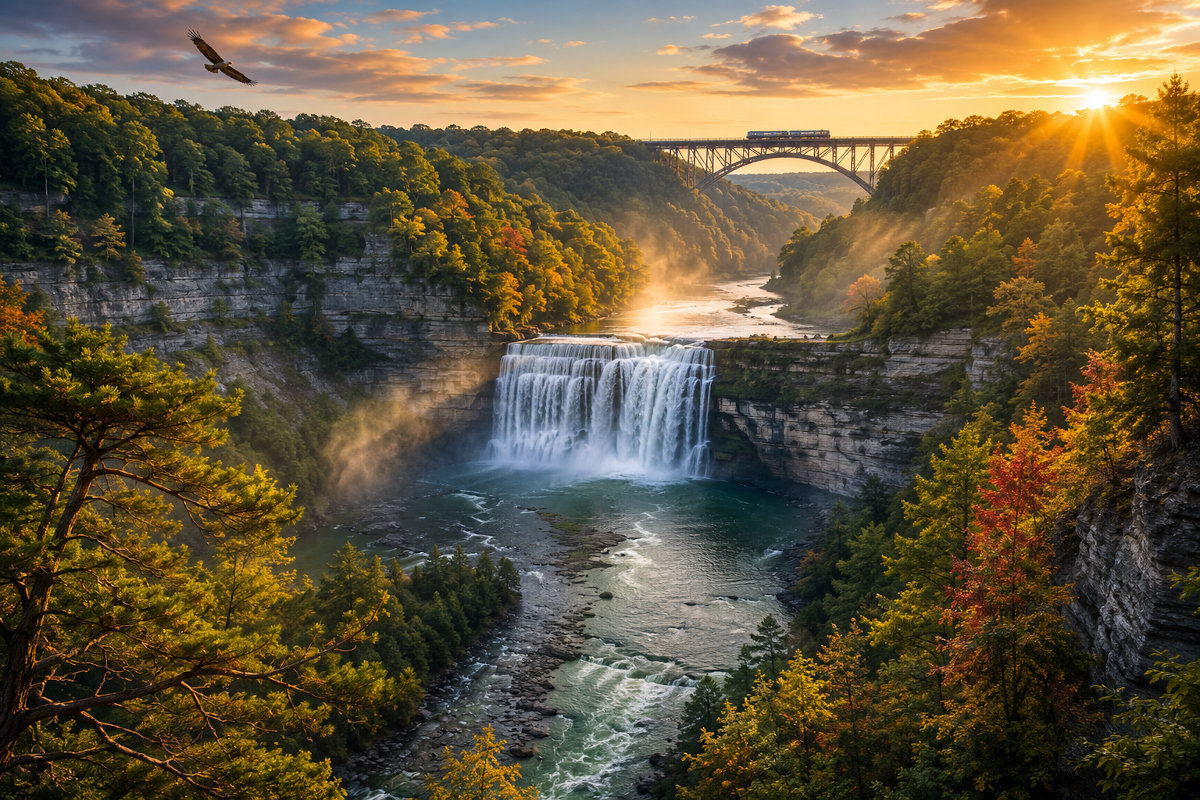
Grand Canyon of the East
This is Letchworth State Park—one of New York State’s most dramatic natural destinations and a place where geology, history, wildlife, and human preservation come together.
Often called the “Grand Canyon of the East,” Letchworth stretches along a wild gorge carved by the Genesee River. The park covers approximately 14,350 acres, includes a gorge about 17 miles long, and contains cliffs that rise as high as 600 feet in some locations.
Yet Letchworth is more than a scenic overlook or a place to photograph waterfalls. It is a landscape that tells the story of ancient seas, moving glaciers, the Seneca people, early tourism, historic preservation, and one man’s decision to protect a remarkable place for future generations.
Why Is Letchworth Called the Grand Canyon of the East?
The comparison becomes understandable the moment you stand at one of the park’s overlooks. Far below, the Genesee River winds between steep rock walls and heavily forested slopes. Waterfalls send mist into the air, while layers of shale, sandstone, and siltstone reveal millions of years of geological history.
Letchworth is not as wide or deep as the Grand Canyon in Arizona, but its combination of a long river gorge, high cliffs, sweeping overlooks, and dramatic waterfalls gives it a scale rarely found elsewhere in the eastern United States.
The name also captures a feeling. Letchworth does not seem like a single attraction. It feels like an entire landscape—one that changes as you follow the river from overlook to overlook.
The Three Major Waterfalls
The Genesee River passes over three major waterfalls in the southern portion of the park: Upper Falls, Middle Falls, and Lower Falls. Each has a different character and offers a different way to experience the river.
Upper Falls
Upper Falls is framed by the steep walls of the gorge and the impressive Genesee Arch Bridge rising above the river. The combination of waterfall, stone, forest, and bridge makes this one of the park’s most recognizable views.
This area clearly shows how nature and engineering can share the same landscape. The river drops over ancient rock while trains cross high above the gorge.
Middle Falls
Middle Falls is the broad, powerful centerpiece of Letchworth State Park. Here, the Genesee River pours over a wide rock ledge near the historic Glen Iris Inn.
Visitors can approach close enough to hear the roar of the water and feel the mist drifting from the gorge. In the evening, changing light can transform the falls, the rock walls, and the surrounding forest into an entirely different scene.
Lower Falls
Lower Falls lies farther downstream in a narrower section of the gorge. Reaching some of its best views requires more walking and stair climbing, giving the area a more secluded and adventurous character.
A stone footbridge crosses the river below the falls, providing a memorable view into the gorge and another perspective on the force of the Genesee River.
A Gorge Built by Rock, Water, and Ice
The exposed rock of Letchworth Gorge was formed from mud and sand deposited in an ancient shallow sea during the Late Devonian Period. Over immense spans of time, those deposits hardened into layers of shale, siltstone, and sandstone.
The gorge seen today was also shaped by glaciers. During the Ice Age, massive sheets of ice moved across New York, altering valleys, redirecting drainage, and leaving thick deposits of sediment behind.
After the last glacial ice retreated roughly 13,000 years ago, the Genesee River continued cutting into the landscape. In some areas it followed older valleys. In others, it carved entirely new channels through bedrock.
This helps explain why the gorge changes character throughout the park. Some sections are narrow and steep, while others are wider and bordered by glacial deposits.
More Waterfalls Than Most Visitors Realize
Upper, Middle, and Lower Falls receive most of the attention, but they are only part of Letchworth’s waterfall story.
Dozens of additional waterfalls and cascades occur along tributary streams entering the gorge. Some appear as thin ribbons dropping over high cliffs. Others become especially visible after heavy rain or during spring snowmelt.
Among them is Inspiration Falls, which descends along the gorge wall near Inspiration Point. These smaller and more distant waterfalls reward visitors who slow down, scan the cliffs, and look beyond the park’s three famous falls.
Sehgahunda: The Vale of Three Falls
Long before Letchworth became a state park, the gorge and surrounding lands were part of the homeland of the Seneca people.
The area was known as Sehgahunda, commonly translated as “the vale of three falls.” The name reflects a deep awareness of the landscape and the three great waterfalls that remain central to the park today.
The Genesee River Valley contains places connected to important Seneca communities and historical figures. The park’s history therefore reaches much farther back than its establishment as a public recreation area.
Understanding Letchworth means recognizing that this was—and remains—a culturally significant landscape, not simply an unoccupied wilderness waiting to become a park.
Mary Jemison and the Council Grounds
One of the most important historic areas within Letchworth is the Council Grounds.
Mary Jemison, also known by her Seneca name Degewanus, was captured as a child during the French and Indian War and later adopted into the Seneca Nation. She chose to remain with the Seneca and became an important figure in the history of the Genesee Valley.
A monument at the Council Grounds honors her life. Her original grave marker and objects connected to her story are preserved within the William Pryor Letchworth Museum.
The Council Grounds also contain a historic Seneca council house that William Pryor Letchworth moved from Caneadea to his estate in 1872 to preserve it. The site offers an opportunity to explore the continuing history and culture of the Seneca and other Haudenosaunee peoples.
William Pryor Letchworth and the Preservation of the Gorge
Letchworth State Park takes its name from William Pryor Letchworth, a businessman, social reformer, historian, and preservationist.
In the nineteenth century, Letchworth purchased property near Middle Falls and developed a private country estate known as Glen Iris. He became deeply attached to the gorge and increasingly concerned about its future.
Letchworth worked to preserve the landscape, historical structures, and objects connected to the Genesee Valley. His interests went beyond scenic beauty. He also supported social reform and sought to document the region’s history.
Rather than allow his estate to be divided or commercially developed, Letchworth arranged for it to become part of New York’s public park system. The park was established in 1907 and gradually expanded to protect a much larger portion of the gorge.
His decision transformed a private retreat into a landscape that millions of people would eventually be able to experience.
The Glen Iris Inn
Overlooking Middle Falls, the Glen Iris Inn began as William Pryor Letchworth’s home within his estate.
The restored historic building now operates as an inn and restaurant. Its location near the falls makes it one of the park’s most distinctive landmarks.
The Glen Iris adds another layer to the Letchworth experience. Visitors can move from rugged cliffs and roaring water to architecture, gardens, stonework, and the atmosphere of a nineteenth-century country estate.
The William Pryor Letchworth Museum
Near the Council Grounds, the William Pryor Letchworth Museum helps visitors understand the human history behind the landscape.
The museum contains exhibits related to William Pryor Letchworth, Mary Jemison, Seneca and Haudenosaunee history, archaeology, early settlement, and the development of the park.
It is easy to visit Letchworth and focus only on the waterfalls. The museum reveals why the park is also an important historical and cultural destination.
The Humphrey Nature Center
The Humphrey Nature Center offers interactive exhibits and educational programs focused on the geology, plants, wildlife, and river ecology of Letchworth State Park.
Exhibits help explain how the gorge formed, how the river shapes the environment, and how plants and animals use the park’s varied habitats.
Outside the center are trails, a butterfly garden, a bird observation station, an outdoor classroom, and access to destinations such as Trout Pond and Inspiration Point.
For families and first-time visitors, the nature center is an excellent place to begin exploring the park.
Hiking and Exploring the Park
Letchworth contains approximately 66 miles of hiking trails. Some follow sections of the gorge rim, while others pass through forest, descend toward the river, or connect overlooks and historic areas.
The Gorge Trail is one of the best-known routes, linking many of the park’s major scenic locations. Visitors do not need to hike the entire trail to enjoy it. Numerous parking areas make it possible to explore shorter sections.
Other trails lead through quieter forests and less-traveled portions of the park. Depending on the trail, hikers may encounter steep slopes, stairs, uneven surfaces, mud, roots, and sudden changes in elevation.
Trail conditions and closures can change, so visitors should consult the current official park map and notices before beginning a hike.
Wildlife in the Genesee Gorge
Letchworth’s forests, river, ponds, cliffs, and open areas provide habitat for a wide range of wildlife.
Visitors may see white-tailed deer, squirrels, chipmunks, wild turkeys, and many species of songbirds. The gorge also creates excellent conditions for observing raptors soaring on rising air currents.
Bald eagles have returned to many waterways across New York, and patient visitors may see them near the Genesee River. Other possible sightings include hawks, vultures, owls, waterfowl, and smaller woodland animals.
The best wildlife experiences often come early or late in the day, when the park is quieter and animals are more active.
Letchworth Through the Seasons
Spring
Spring brings strong water flow, fresh green growth, woodland wildflowers, and the sound of tributary streams rushing toward the gorge. Trails may be wet or muddy, but the waterfalls can be especially powerful.
Summer
Summer offers the fullest range of activities, programs, camping, picnicking, hiking, and sightseeing. Dense foliage frames the gorge, and long daylight hours make it easier to explore several areas in one visit.
Fall
Autumn is one of Letchworth’s most celebrated seasons. Red, orange, yellow, and gold foliage spreads across the gorge walls, creating spectacular views from the park’s many overlooks.
Fall weekends can be busy, so arriving early often provides a quieter experience.
Winter
Snow and ice transform Letchworth into a quieter and more dramatic landscape. Frozen spray, snow-covered cliffs, bare trees, and partially frozen waterfalls reveal shapes that are hidden during the warmer months.
Winter visitors should be prepared for changing road, trail, and weather conditions.
Scenic Overlooks Worth Finding
Letchworth contains many overlooks, and each offers a different view of the gorge.
Inspiration Point
Inspiration Point provides one of the park’s classic panoramic views. From here, visitors can look toward Middle Falls, Upper Falls, the gorge, and the Genesee Arch Bridge.
Great Bend Overlook
At Great Bend, the Genesee River makes a sweeping curve through a broad section of the gorge. This view helps visitors understand the scale and changing form of the valley.
Archery Field Overlook
This overlook offers another expansive perspective into the gorge and is an excellent place to study the layers of forest, rock, and river below.
Hogsback Overlook
Hogsback overlooks a narrow ridge encircled by a bend in the Genesee River. It is one of the most unusual landforms visible from the park road.
Things to Notice
- Rock layers: Look for horizontal bands of shale, sandstone, and siltstone exposed along the gorge walls.
- Side waterfalls: Scan the opposite cliffs for narrow streams dropping toward the river.
- Changing gorge shapes: Compare the narrow upper gorge with wider portions farther north.
- Historic stonework: Notice walls, steps, bridges, and structures built to fit naturally into the landscape.
- Soaring birds: Watch above the gorge for eagles, hawks, and vultures using rising air currents.
- Sound: Stop away from busy overlooks and listen to the river, waterfalls, wind, birds, and moving leaves.
- Seasonal light: Morning mist, evening light, autumn color, and winter ice can make the same view look entirely new.
Activities Beyond Sightseeing
Letchworth offers much more than overlooks and hiking. Depending on the season and current availability, activities may include:
- Camping and cabin stays
- Picnicking
- Fishing
- Guided nature and history programs
- Whitewater rafting
- Kayaking
- Hot-air balloon rides
- Horseback riding
- Biking
- Cross-country skiing
- Snowshoeing
- Snowmobiling
- Photography and birdwatching
Some activities are seasonal, weather-dependent, or operated by outside providers. Availability should be confirmed before traveling.
Planning Your First Visit
Letchworth is large enough that trying to see everything in a few hours can feel rushed. A first visit is often most enjoyable when it focuses on the southern section of the park.
A good introductory route may include:
- Upper Falls and the Genesee Arch Bridge
- Middle Falls
- The Glen Iris Inn area
- The William Pryor Letchworth Museum and Council Grounds
- Inspiration Point
- The Humphrey Nature Center
Visitors with additional time can continue north to Great Bend, Hogsback, Mount Morris Dam overlooks, and quieter sections of the park.
Photography Tips
- Visit early in the morning for softer light, mist, and fewer people.
- Use a wide view to show the relationship between the river, falls, cliffs, and forest.
- Use a longer lens to isolate distant waterfalls, rock layers, wildlife, and details along the gorge walls.
- Overcast days can help reduce harsh glare on waterfalls.
- Autumn color is spectacular, but bare trees in late fall and winter can reveal more of the gorge’s geology.
- Protect cameras and phones from mist near Middle Falls.
- Remain behind barriers and avoid unstable cliff edges while taking photographs.
Things to Know Before You Go
- The park is open year-round, but some roads, buildings, trails, accommodations, and services operate seasonally.
- A vehicle entrance fee may be collected during the main season.
- Trail closures and conditions can change because of weather, erosion, construction, or maintenance.
- Download or carry a current park map before exploring longer trails.
- Cell service may be limited in parts of the gorge.
- Bring water, suitable footwear, and clothing appropriate for changing conditions.
- Supervise children carefully near overlooks, roads, waterfalls, and steep terrain.
- Pets must follow current New York State Parks rules and should remain leashed where required.
- Never climb barriers or approach the river near waterfalls.
Why Letchworth Matters
Letchworth State Park protects far more than beautiful scenery.
It preserves a geological record written in ancient rock. It protects forests, wildlife habitat, waterfalls, and miles of the Genesee River. It carries the history of the Seneca people and the wider Genesee Valley. It preserves the story of Mary Jemison, the Council Grounds, Glen Iris, and William Pryor Letchworth’s commitment to conservation.
Most of all, it shows what can happen when a remarkable landscape is valued before it is lost.
Letchworth invites visitors to do more than take a photograph and move on. It rewards curiosity. Look at the layers in the cliffs. Listen to the river. Learn the names and stories connected to the land. Follow a trail beyond the busiest overlook.
Every part of the park reveals another chapter in the story of New York State.
Quick Facts
- Location: Genesee River Valley in western New York
- Primary address: 1 Letchworth State Park, Castile, New York
- Region: Genesee Region
- Park size: Approximately 14,350 acres
- Gorge length: Approximately 17 miles
- Major waterfalls: Upper Falls, Middle Falls, and Lower Falls
- Cliff height: Up to approximately 600 feet in some areas
- Hiking trails: Approximately 66 miles
- Historic sites: Glen Iris Inn, Council Grounds, and William Pryor Letchworth Museum
- Nature education: Humphrey Nature Center
- Best known for: Waterfalls, gorge overlooks, geology, history, hiking, and fall foliage
Learn More Before Visiting
Hours, admission fees, trail conditions, seasonal openings, camping availability, and activity schedules can change. Check the official New York State Parks page before traveling.
Visit the Official Letchworth State Park Website
Discover New York State at discovernys.com