003 Thousand Islands: Where the St. Lawrence River Becomes a World of Islands
The Thousand Islands — an international region shared by New York State and Ontario, Canada.
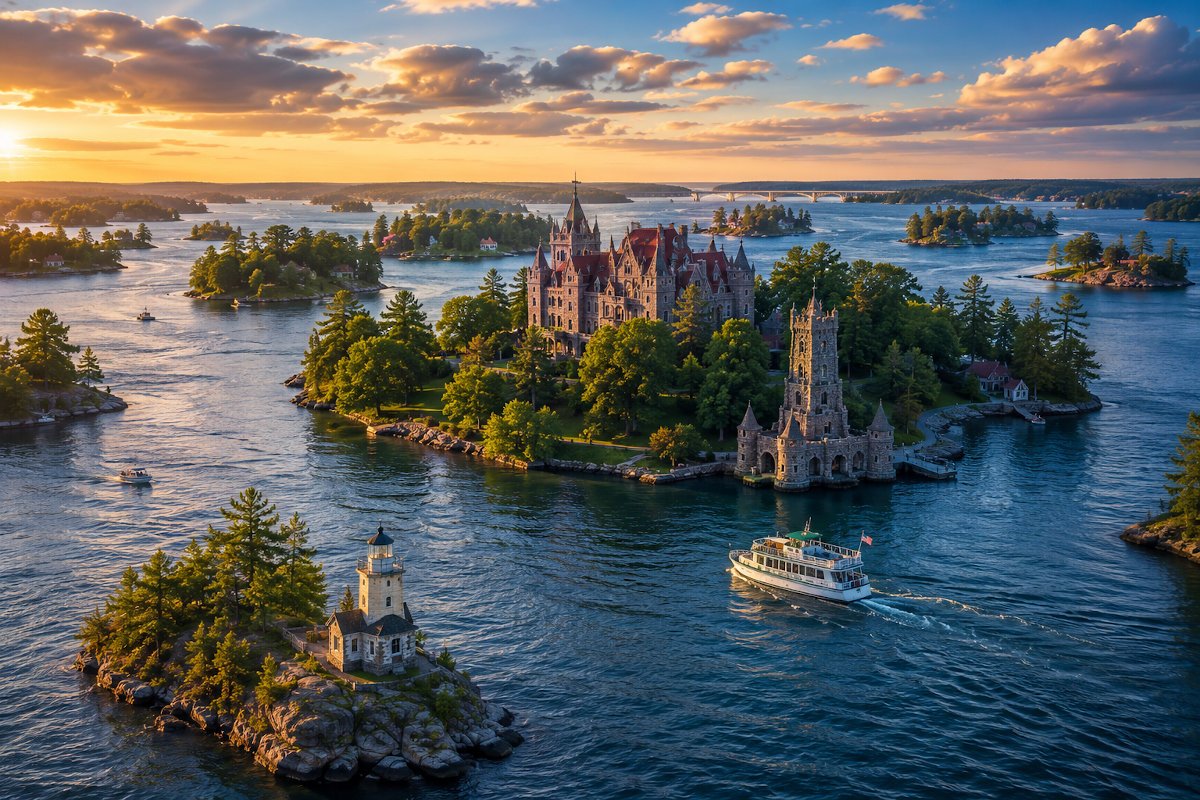
The Magic of New York State Thousand Islands
At the eastern end of Lake Ontario, the St. Lawrence River begins a journey toward the Atlantic Ocean. Almost immediately, the river encounters an extraordinary landscape of granite, forest, narrow channels, hidden coves, historic communities, lighthouses, castles, and islands of nearly every imaginable size.
Some islands are large enough to contain roads, farms, forests, state parks, and entire communities. Others hold a single cottage, a lighthouse, a few wind-shaped trees, or nothing more than exposed granite and a resting bird.
The Thousand Islands is not simply one destination. It is an interconnected landscape shaped by glaciers, water, wildlife, international commerce, Indigenous history, shipbuilding, tourism, and generations of people who have made their lives along the St. Lawrence River.
It is a place best explored slowly—by boat, by kayak, along the shoreline, from an overlook, through a historic village, or simply by standing beside the river and watching the world pass.
Are There Really One Thousand Islands?
There are actually more than one thousand.
The traditional count commonly associated with the region is 1,864 islands, scattered through the St. Lawrence River between northeastern Lake Ontario and the area near Brockville, Ontario.
To qualify as one of the Thousand Islands, a piece of land is traditionally expected to:
- Remain above water throughout the year
- Have an area of at least approximately one square foot
- Support at least two living trees or shrubs
These informal rules help distinguish a true island from a temporarily exposed rock.
The exact total can vary depending on mapping methods, water levels, and the definition being used. What matters most is not the final number, but the remarkable concentration of islands within a relatively narrow section of the river.
A Landscape Shaped by Ice
The foundation of the Thousand Islands is ancient rock, but the landscape visible today was greatly shaped by glaciers.
During the Ice Age, immense sheets of ice moved across New York and Ontario. The glaciers scraped and polished bedrock, widened valleys, carried sediment, and altered the drainage of the region.
As the ice retreated, water filled low areas between the exposed rock ridges. The higher portions remained above the surface as islands.
The result is sometimes described as a drowned landscape. What appear to be separate islands are actually the visible summits and ridges of an ancient terrain extending beneath the river.
Many islands contain exposed granite, rounded rock surfaces, thin soil, white pine, cedar, oak, and vegetation adapted to shallow ground and strong winds.
The Frontenac Arch
The Thousand Islands lies along a geological feature known as the Frontenac Arch.
This band of ancient rock connects the Canadian Shield in Ontario with the Adirondack Mountains of New York. Where it crosses the St. Lawrence River, its higher ridges become the islands of the archipelago.
The Frontenac Arch is more than a geological connection. It also creates an important ecological corridor between northern and southern environments.
Plants and animals from different regions meet here, contributing to the unusual biological diversity of the Thousand Islands.
The same granite that shapes the islands also appears in foundations, walls, docks, bridges, towers, and historic buildings throughout the region.
Where Lake Ontario Becomes the St. Lawrence River
The Thousand Islands begins near the point where water leaves Lake Ontario and enters the St. Lawrence River.
This transition is not marked by one dramatic line. Instead, the broad waters gradually narrow and begin winding among islands, channels, shoals, and rocky points.
The river eventually carries water northeast toward Montreal, Quebec City, the Gulf of St. Lawrence, and the Atlantic Ocean.
Because of this connection, ships traveling through the region may have arrived from ports around the world.
Ocean-going vessels, cargo ships, tour boats, fishing boats, sailboats, kayaks, historic launches, and private vessels all share portions of this remarkable waterway.
A River Shared by Two Nations
The international border between the United States and Canada passes through the Thousand Islands.
Some islands are in New York. Others are in Ontario. In many locations, the international boundary runs through channels that appear completely natural and uninterrupted.
The border does not divide the visual landscape. Islands, birds, weather, water, and forests continue across both countries.
Communities on the American and Canadian sides have long shared relationships involving transportation, commerce, tourism, fishing, family connections, and life along the river.
The region is therefore best understood as one landscape shared by two nations.
Indigenous History Along the St. Lawrence
The Thousand Islands region has a human history extending thousands of years before European settlement.
Indigenous peoples traveled, fished, hunted, traded, and lived along the St. Lawrence River and the waterways connected to it.
The Haudenosaunee, also known as the Iroquois Confederacy, maintain deep cultural and historical connections to this wider region. The river provided food, transportation, communication, and access between communities.
Waterways were the original highways. Long before modern roads and bridges, people could travel great distances by canoe through rivers, lakes, bays, and protected channels.
Understanding the Thousand Islands begins with recognizing that its history did not start with castles, steamships, or tourism. It began with people whose knowledge of the river developed over countless generations.
Exploration, Trade, and Conflict
European explorers and traders entered the St. Lawrence River during the sixteenth and seventeenth centuries.
The river became part of a vast network connecting the interior of North America with the Atlantic Ocean. Furs, supplies, people, military forces, and information moved through the region.
Because the river held strategic importance, the Thousand Islands and nearby communities were affected by conflicts between European powers and, later, the United States and British-controlled Canada.
The War of 1812 brought military activity, naval competition, privateering, and uncertainty to communities along Lake Ontario and the St. Lawrence River.
Historic sites throughout northern New York and eastern Ontario preserve pieces of this larger story.
From Working River to Vacation Destination
For much of its history, the St. Lawrence was primarily a working river.
Boats transported timber, agricultural products, manufactured goods, mail, passengers, and supplies. Shipyards and skilled craftspeople developed along the shoreline. Fishing supported both families and businesses.
During the nineteenth century, improved transportation introduced the scenery of the Thousand Islands to a much wider audience.
Steamships carried visitors through the channels. Railroads made the region more accessible from major cities. Hotels, boarding houses, summer communities, and private estates appeared along the river.
By the late nineteenth and early twentieth centuries, the Thousand Islands had become one of North America’s most fashionable summer destinations.
The Gilded Age on the River
Wealthy families from New York City, Philadelphia, Pittsburgh, Chicago, and other industrial centers began building elaborate summer homes throughout the islands.
Some called their properties cottages, even when the buildings contained towers, ballrooms, libraries, guest wings, boathouses, formal gardens, and dozens of rooms.
Architects and craftspeople created estates in styles that included Romanesque, Queen Anne, Shingle Style, Classical Revival, and castle-inspired designs.
The islands offered privacy, cool summer weather, fishing, boating, social gatherings, and a dramatic natural setting.
This period left the Thousand Islands with an extraordinary collection of architecture, boathouses, clubs, hotels, churches, and waterfront communities.
Boldt Castle and Heart Island
Boldt Castle is the best-known landmark in the Thousand Islands.
Located on Heart Island near Alexandria Bay, the castle was commissioned by hotelier George C. Boldt as a grand summer residence for his wife, Louise.
Construction began around the beginning of the twentieth century. Hundreds of workers contributed to an elaborate complex that included the main castle, Power House, Alster Tower, gardens, tunnels, docks, and other structures.
Work stopped suddenly following Louise Boldt’s death in 1904.
The unfinished property remained exposed to weather and vandalism for decades. In 1977, the Thousand Islands Bridge Authority acquired Heart Island and began a long-term restoration effort.
Today, visitors can tour the castle and grounds while seeing both restored spaces and evidence of the building’s unfinished history.
Boldt Castle is more than an extravagant house. It is a story of ambition, love, loss, abandonment, and preservation.
The Boldt Yacht House
Across the water from Heart Island on nearby Wellesley Island stands the Boldt Yacht House.
The building was designed to shelter the Boldt family’s boats and includes an enormous interior space, distinctive towers, and elaborate architectural details.
Historic boats displayed within the Yacht House help visitors understand the importance of private steam yachts, launches, racing boats, and pleasure craft during the Gilded Age.
The structure demonstrates that boating was not merely transportation. It was central to the social and recreational life of the Thousand Islands.
Singer Castle on Dark Island
Singer Castle offers a very different castle experience.
Located on Dark Island, the structure was built for Frederick Gilbert Bourne, who served as president of the Singer Sewing Machine Company.
The castle includes stone towers, wood-paneled rooms, hidden passages, concealed doors, a library, fireplaces, terraces, and views across the St. Lawrence River.
Its more remote location and fortress-like architecture give it an atmosphere unlike Boldt Castle.
Because Singer Castle is located on an island without a public bridge, visitors generally arrive by tour boat or private vessel.
Alexandria Bay
Alexandria Bay is one of the best-known communities on the American side of the Thousand Islands.
The village developed as a center for boating, hotels, fishing, tourism, and river transportation. Its waterfront faces some of the region’s most recognizable islands, including Heart Island.
Visitors can find boat tours, docks, restaurants, shops, lodging, public waterfront spaces, and views of passing vessels.
Alexandria Bay is often the starting point for excursions to Boldt Castle and other parts of the river.
Clayton
Clayton combines a historic village, active waterfront, maritime culture, museums, restaurants, shops, and access to the St. Lawrence River.
The community has long been associated with shipbuilding, fishing, boating, and tourism.
Its waterfront provides views of islands, working vessels, recreational boats, and the changing river.
Clayton also serves as an excellent base for exploring the western portion of the Thousand Islands region.
The Antique Boat Museum
The Antique Boat Museum in Clayton preserves one of the world’s significant collections related to recreational boating and North American freshwater maritime history.
The museum’s collections include historic watercraft, engines, photographs, models, artifacts, racing boats, canoes, launches, and examples of the remarkable craftsmanship associated with wooden boats.
One of the museum’s best-known vessels is La Duchesse, a large Gilded Age houseboat built for hotelier George Boldt.
The museum helps visitors understand that the Thousand Islands was not simply a backdrop for boating. It was a center of boat design, construction, innovation, sport, and culture.
Wellesley Island State Park
Wellesley Island State Park is one of the most extensive public recreation areas in the Thousand Islands.
The park includes camping, cabins, cottages, trails, picnic areas, fishing access, a marina, boat launches, swimming, and views of the St. Lawrence River.
Its size and range of facilities make it a useful base for visitors who want to spend several days exploring the region.
Wellesley Island also demonstrates the diversity of the islands. Rather than being a small outcrop, it contains roads, neighborhoods, forests, wetlands, rocky shorelines, and several distinct destinations.
Minna Anthony Common Nature Center
Located within Wellesley Island State Park, the Minna Anthony Common Nature Center introduces visitors to the natural side of the Thousand Islands.
Trails lead through forest, wetlands, rocky outcrops, and shoreline habitats. Exhibits and programs explore the geology, wildlife, plants, and ecology of the region.
The nature center offers a valuable contrast to the castles and historic communities. It reminds visitors that the islands existed as a complex natural system long before tourism and private estates arrived.
Rock Island Lighthouse
Rock Island Lighthouse stands near an important shipping channel in the St. Lawrence River.
The lighthouse complex helps tell the story of navigation, lighthouse keepers, maritime safety, and the challenges of guiding vessels through a river filled with islands, shoals, currents, and narrow passages.
Visitors arriving by boat can explore the island and gain a closer understanding of the region’s working maritime history.
From the island, the river appears very different than it does from shore. Channels, islands, passing ships, and distant communities become part of one continuous view.
Sunken Rock Lighthouse
Near Alexandria Bay, Sunken Rock Lighthouse marks a dangerous shoal in the river.
Its compact form standing directly in the water makes it one of the most recognizable small lighthouses in the Thousand Islands.
It also demonstrates why navigation aids were essential. Beneath the beautiful surface of the St. Lawrence are rocks and shoals capable of damaging vessels unfamiliar with the river.
The Thousand Islands Bridge
The Thousand Islands Bridge system connects the United States and Canada across the St. Lawrence River.
Rather than one single bridge, the crossing consists of several spans linking the mainland and islands between northern New York and Ontario.
The most visually dramatic section crosses the American channel near Wellesley Island.
From nearby viewpoints, the bridge appears to rise above forested islands and blue water, creating one of the region’s defining modern landmarks.
The bridge represents transportation and international connection, continuing the region’s long role as a meeting place between nations.
The St. Lawrence Seaway
The St. Lawrence Seaway transformed the river into part of a major international shipping system.
Locks, channels, navigation improvements, and related infrastructure allow ocean-going ships to travel between the Atlantic Ocean and the Great Lakes.
Large cargo ships passing surprisingly close to small islands are one of the most memorable sights in the Thousand Islands.
These ships may carry grain, iron ore, steel, machinery, salt, petroleum products, or other cargo between inland ports and destinations around the world.
The contrast is remarkable: a quiet cottage may stand on a small granite island while an enormous international freighter moves through the channel nearby.
Island Homes and Boathouses
Not every memorable building in the Thousand Islands is a castle.
The region contains an extraordinary variety of island homes, cottages, boathouses, hotels, churches, clubs, and seasonal communities.
Some houses occupy spacious wooded islands. Others appear to use nearly every available foot of a small rock.
Boathouses are especially important to the region’s architecture. Many were designed with the same attention to detail as the homes they served, featuring towers, decorative shingles, balconies, stained glass, carved woodwork, and large interior slips.
These buildings reflect the fact that, on many islands, the boat was the family automobile and the dock was the front door.
Thousand Island Park
Thousand Island Park is a historic summer community on Wellesley Island.
Founded during the nineteenth century, the community contains an unusual concentration of Victorian-era cottages, public buildings, porches, narrow streets, decorative woodwork, and waterfront spaces.
The architecture ranges from modest cottages to elaborate houses filled with gingerbread trim, towers, balconies, patterned shingles, and bright colors.
Walking through the community offers a very different experience from touring a castle. It reveals how families created an entire seasonal village around life on the river.
How People Explore the Thousand Islands
Boat Tours
For many visitors, a boat tour is the best introduction to the region.
From the water, it becomes possible to understand the spacing of the islands, the location of the international border, the scale of the shipping channels, and the relationship between castles, cottages, lighthouses, and natural areas.
Tours vary in length and route. Some focus on Boldt Castle, while others travel deeper into the archipelago or include Canadian waters.
Kayaking and Canoeing
Paddling offers a quieter and more intimate experience.
Kayaks and canoes can enter protected bays, narrow channels, and shallow areas inaccessible to larger boats.
Currents, wind, waves, cold water, ship traffic, and rapidly changing weather can create serious hazards. Paddlers should use appropriate safety equipment, understand local conditions, and avoid major shipping channels unless properly prepared.
Scenic Driving
New York State Route 12 follows portions of the St. Lawrence River between communities such as Clayton, Alexandria Bay, and Morristown.
Side roads lead to state parks, river overlooks, marinas, historic communities, farms, and quieter sections of shoreline.
A scenic drive can reveal how quickly the landscape changes between open agricultural country, exposed granite, woodland, villages, bays, and broad river views.
Fishing
The Thousand Islands is known for freshwater fishing.
Species include smallmouth bass, northern pike, muskellunge, walleye, yellow perch, and others.
Fishing from shore, docks, private boats, and charter vessels remains an important part of local recreation and culture.
Visitors should review current New York or Ontario fishing regulations depending on where they plan to fish.
Hiking and Nature Study
Although the region is best known for water, it also contains trails through forest, wetland, shoreline, and exposed granite terrain.
Wellesley Island State Park and the Minna Anthony Common Nature Center provide some of the most accessible opportunities on the New York side.
Walking slowly through these habitats reveals a side of the Thousand Islands that can easily be missed from a tour boat.
Wildlife of the Thousand Islands
The St. Lawrence River and its islands support a rich variety of wildlife.
Visitors may see:
- Bald eagles
- Ospreys
- Great blue herons
- Common loons
- Gulls and terns
- Ducks and geese
- White-tailed deer
- River otters
- Beavers
- Mink
- Turtles
- Songbirds and migratory warblers
Bald eagles and ospreys may be seen flying above the river or watching from tall trees.
Wetlands and protected bays provide nursery areas for fish and habitat for waterfowl, amphibians, reptiles, insects, and aquatic plants.
Quiet observation early or late in the day often produces the best wildlife experiences.
Things to Notice
- Exposed granite: Look for smooth, rounded rock shaped and polished by glacial ice.
- Wind-shaped trees: Pines and cedars may lean or twist in response to constant exposure.
- Island size: Compare islands containing large estates with rocks supporting only a few trees.
- Water color: Depth, sunlight, wind, clouds, and vegetation continually change the river’s appearance.
- Navigation markers: Buoys and lights reveal safe channels among submerged rocks and shoals.
- Historic boathouses: Notice towers, shingles, balconies, windows, and decorative woodwork.
- International traffic: Ships, boats, and travelers move between two countries within one landscape.
- Wildlife perches: Watch dead branches and tall pines for eagles and ospreys.
- Protected coves: Calm bays may contain water lilies, reeds, fish, turtles, and waterfowl.
- Changing scale: A ship that looks small in the distance may become enormous as it enters a nearby channel.
Can You Find These?
During your visit, see whether you can find:
- An island with only one house
- A rock supporting just a few trees
- A castle tower rising above the forest
- A lighthouse standing directly in the river
- An ocean-going ship passing a small cottage
- A bald eagle or osprey watching the water
- A wooden boathouse more elaborate than many homes
- A place where the United States and Canada are visible at the same time
- Glacial scratches or smooth surfaces on exposed granite
- A narrow channel hidden between two islands
The Thousand Islands Through the Seasons
Spring
Spring brings flowing water, returning birds, cool temperatures, budding trees, and the reopening of seasonal attractions.
Weather can change quickly, and the river remains cold even when the air feels warm.
Summer
Summer is the region’s busiest season.
Boat tours, castles, museums, parks, marinas, fishing, paddling, swimming, camping, restaurants, and waterfront communities are generally at their most active.
Long daylight hours allow visitors to combine several experiences in one day.
Fall
Autumn brings colorful foliage, cooler temperatures, fewer insects, migrating birds, and dramatic reflections on the river.
Some seasonal attractions and boat tours reduce operations as fall progresses, so schedules should be checked before traveling.
Winter
Winter reveals a quieter version of the Thousand Islands.
Snow covers cottages and granite shorelines. Ice develops in protected bays and along portions of the river. Bare trees open views that are hidden during summer.
The main shipping channel may remain active even while smaller waterways appear frozen.
Photography Tips
- Photograph early in the morning for calm water, mist, reflections, and softer light.
- Use evening light to illuminate islands, castles, and passing boats.
- Include a boat, house, lighthouse, or bridge to show the scale of the river.
- Use a longer lens for eagles, distant castles, ships, and architectural details.
- Use a wide view to show layers of islands fading toward the horizon.
- Look for reflections when the river is calm.
- Photograph from both land and water whenever possible.
- Protect cameras and phones from spray, rain, and sudden weather changes.
- Never operate a boat or paddlecraft while distracted by photography.
Planning a First Visit
The Thousand Islands is too large and varied to experience fully in one day.
A good introductory visit on the New York side might include:
- Exploring the waterfront in Alexandria Bay
- Taking a boat tour through the islands
- Visiting Boldt Castle on Heart Island
- Driving across or viewing the Thousand Islands Bridge
- Exploring Wellesley Island State Park
- Walking trails at the Minna Anthony Common Nature Center
- Visiting Clayton and the Antique Boat Museum
- Watching the sunset beside the St. Lawrence River
Visitors with more time can add Singer Castle, Rock Island Lighthouse, Thousand Island Park, additional state parks, fishing, paddling, Canadian communities, and quiet drives along the river.
Things to Know Before You Go
- Many attractions, tours, museums, accommodations, and island sites operate seasonally.
- Boat schedules and routes may change because of weather, water conditions, or maintenance.
- A passport or other approved documentation may be required when entering Canada or landing at a Canadian destination.
- Do not assume that remaining aboard a tour boat and entering another country have the same documentation requirements.
- International boating regulations may apply when crossing the border by private vessel.
- The St. Lawrence River can be cold, deep, swift, and affected by rapidly changing weather.
- Large commercial ships have limited ability to stop or change course.
- Use personal flotation devices and appropriate navigation equipment when boating or paddling.
- Confirm park hours, admission fees, ferry service, boat tours, and accessibility before traveling.
- Cell service may vary among islands and remote sections of shoreline.
- Respect private islands, residences, docks, and posted property boundaries.
Nearby Discoveries
Sackets Harbor
Sackets Harbor preserves an important Lake Ontario community associated with the War of 1812, shipbuilding, military history, and nineteenth-century development.
Cape Vincent
Cape Vincent stands where Lake Ontario meets the St. Lawrence River and offers lighthouses, waterfront views, ferry connections, and access to the western gateway of the Thousand Islands.
Tibbetts Point Lighthouse
Near Cape Vincent, Tibbetts Point Lighthouse marks the transition between Lake Ontario and the St. Lawrence River.
Morristown
Farther northeast, Morristown offers river views and access to historic sites associated with the wider Thousand Islands region.
Thousand Islands National Park
On the Canadian side, Thousand Islands National Park protects islands and mainland properties offering camping, paddling, hiking, and opportunities to explore the natural landscape.
Why the Thousand Islands Matters
The Thousand Islands is one of the places where New York’s story becomes international.
Ancient rock connects the Adirondacks with the Canadian Shield. The St. Lawrence River connects the Great Lakes with the Atlantic Ocean. Islands connect wildlife habitats. Bridges and boats connect two nations.
The region preserves Indigenous history, maritime heritage, working communities, natural shorelines, Gilded Age architecture, lighthouses, state parks, shipbuilding traditions, and an active international waterway.
It also demonstrates that a landscape does not need to belong entirely to one state or country to possess a shared identity.
From a granite island holding two trees to a castle containing hundreds of rooms, every part of the Thousand Islands contributes to the larger story.
The river ties them all together.
Quick Facts
- Location: St. Lawrence River between northern New York and southeastern Ontario
- Traditional island count: 1,864
- Countries: United States and Canada
- New York counties: Primarily Jefferson and St. Lawrence counties
- Major communities: Alexandria Bay, Clayton, Cape Vincent, and nearby river communities
- Major geological feature: Frontenac Arch
- Best known for: Islands, boating, castles, lighthouses, fishing, state parks, maritime history, and international scenery
- Famous landmarks: Boldt Castle, Singer Castle, Thousand Islands Bridge, Rock Island Lighthouse, and Sunken Rock Lighthouse
- Major museum: Antique Boat Museum in Clayton
- Major public park: Wellesley Island State Park
- Waterway: St. Lawrence River and St. Lawrence Seaway
- Best general visiting season: Late spring through early fall, although the region can be explored year-round
Learn More Before Visiting
Hours, border requirements, admission fees, boat tours, castle schedules, park facilities, fishing regulations, and seasonal services can change. Consult official sources before traveling.
Visit the Official Thousand Islands Tourism Website
Explore New York State Parks in the Thousand Islands Region
Visit the Official Boldt Castle Website
Visit the Antique Boat Museum Website
Discover New York State at DiscoverNYS.com
A Field Guide to New York State... Feeding Your Curiosity.