026 Capital Region & Eastern New York Stone Trail: Slate, Limestone, Marble, and Civic Architecture
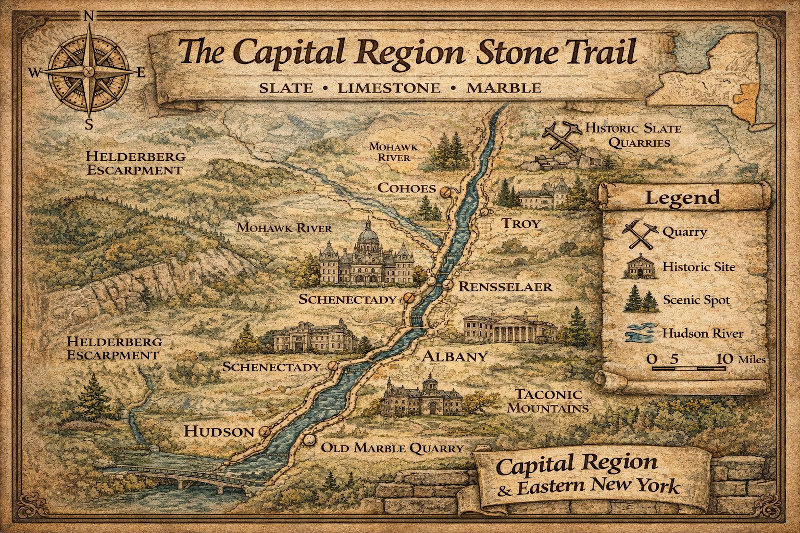
In New York’s Capital Region and eastern counties, stone was more than a building material — it was a statement of permanence, authority, and craftsmanship. From slate-roofed courthouses to limestone foundations and marble halls, the region’s civic architecture reflects a time when public buildings were designed to last for generations.
The Capital Region & Eastern New York Stone Trail explores how local stone shaped the identity of government centers, institutions, and historic communities throughout the region.
Why Stone Defined the Capital Region
As New York grew into a political and economic powerhouse during the 19th century, its capital region demanded buildings that projected stability and importance. Stone offered exactly that.
With easy access to quarries and transportation routes along the Hudson River, canals, and rail lines, builders relied heavily on local stone to construct:
- State and county government buildings
- Courthouses and municipal halls
- Libraries and educational institutions
- Churches and civic landmarks
Slate: Roofing the Institutions of Government
Slate roofing became a defining feature of eastern New York’s public buildings. Durable, fire-resistant, and visually refined, slate was the preferred choice for courthouses, schools, and administrative buildings.
Many slate roofs installed more than a century ago remain in service today, a quiet reminder of both the material’s longevity and the craftsmanship behind it.
Limestone: The Structural Backbone
Limestone and dolostone formed the structural backbone of many buildings throughout the Capital Region. These stones were widely used for:
- Foundations and load-bearing walls
- Courthouse facades
- Steps, columns, and retaining walls
- Bridges and infrastructure
The neutral tones and workability of limestone made it ideal for formal architecture, particularly where symmetry and scale were important.
Marble: Civic Grandeur and Refinement
Marble added elegance and authority to public spaces. In eastern New York, marble was commonly used for:
- Interior staircases and floors
- Columns, trim, and decorative details
- Monuments and memorials
Its polished surfaces and light coloration helped elevate the interiors of government buildings, churches, and institutions.
Civic Architecture Along the Stone Trail
Travelers exploring the Capital Region Stone Trail will encounter stone architecture in:
- State capitol complexes and legislative buildings
- County courthouses and historic town halls
- University campuses and libraries
- Historic churches and civic monuments
In many cases, the stone used in these structures was sourced locally, reinforcing a strong regional identity.
Quarries, Craftsmen, and Communities
The stone industry supported generations of quarry workers, stonecutters, masons, and transport crews. Entire communities grew around quarry operations, and the skills developed in eastern New York helped build cities throughout the Northeast.
Today, this heritage remains visible in preserved buildings, reclaimed quarry sites, and the enduring quality of the stonework itself.
Experiencing the Capital Region Stone Trail
The Stone Trail can be experienced through scenic drives, walking tours, and visits to historic districts. Look closely at:
- Rooflines and dormers
- Foundation stones and wall joints
- Steps, columns, and entryways
- Monuments and memorials
Stone reveals itself slowly, rewarding those who take the time to observe.
Preservation and the Future of Stone Buildings
Preserving historic stone structures remains an important priority throughout the Capital Region. Rather than replacement, many efforts focus on careful repair, maintenance, and adaptive reuse.
This approach honors both the original materials and the craftsmanship that made these buildings endure.
A Legacy Set in Stone
The Capital Region & Eastern New York Stone Trail highlights how geology, design, and civic purpose came together to create enduring architecture. These buildings continue to serve their communities — solid, dignified, and deeply rooted in place.
In the heart of New York’s government and institutions, stone tells a story of permanence, pride, and public trust.