034 The Hudson Valley Stone Trail: Bluestone, Slate, and the Architecture of a Region
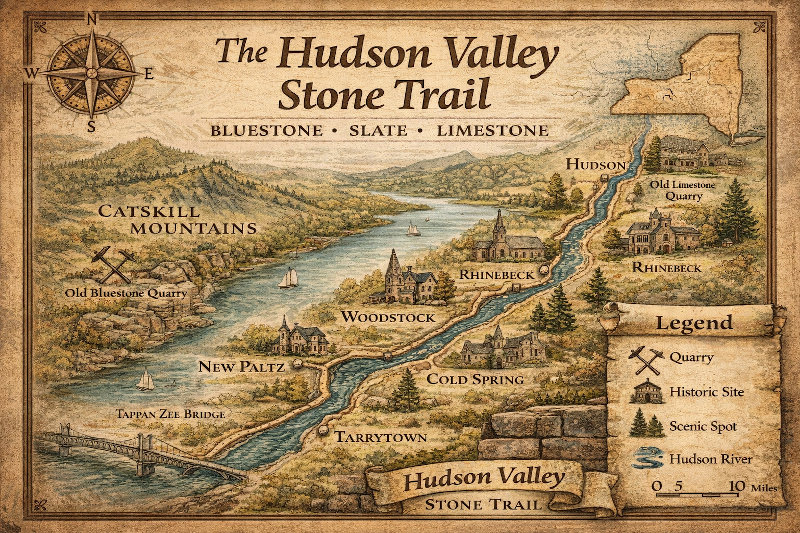
The Hudson Valley is one of New York State’s most visually distinctive regions — not only because of its river, hills, and historic towns, but because of the stone beneath it. From slate roofs and bluestone sidewalks to grand civic buildings and farm walls, local stone has shaped the Hudson Valley’s character for centuries.
The Hudson Valley Stone Trail invites travelers to explore this legacy through scenic drives, walkable villages, and historic landmarks built from the region’s own geology.
Why the Hudson Valley Is Central to New York’s Stone Story
The Hudson Valley sits atop rich deposits of bluestone, slate, limestone, and other building stone. During the 19th and early 20th centuries, quarries throughout the region supplied materials that were shipped by river, rail, and canal to cities across the Northeast.
Because transportation was readily available, Hudson Valley stone became widely used — yet the most impressive examples remain right where the stone was pulled from the ground.
Bluestone: The Sidewalks Beneath Your Feet
Bluestone is perhaps the most iconic Hudson Valley material. Quarried primarily in the Catskills and western Hudson Valley, bluestone was used extensively for:
- Sidewalks and curbs
- Steps and stoops
- Patios and terraces
- Foundations and retaining walls
Walk through historic towns like Kingston, Hudson, or New Paltz, and you’ll often be standing on original bluestone slabs that have endured generations of use.
Slate Roofs: A View from Above
Slate roofing became widespread in the Hudson Valley during the 1800s. Durable, fire-resistant, and naturally beautiful, slate roofs crowned homes, churches, schools, and civic buildings throughout the region.
Many of these roofs remain intact today, quietly protecting structures that are well over a century old — a testament to the material and the craftsmen who installed it.
Historic Buildings Along the Trail
The Hudson Valley Stone Trail can be experienced by simply exploring historic districts and villages. Look for stone in:
- Churches with slate roofs and stone walls
- Courthouses and municipal buildings
- Estate homes and farmhouses
- Canal-era warehouses and industrial structures
Often, the stone used in these buildings came from quarries just miles away.
Quarry Towns and Stone Communities
Many Hudson Valley towns grew directly from the stone industry. Quarry workers, masons, and transport crews formed tight-knit communities whose labor helped build cities far beyond the valley.
Today, traces of this heritage can still be seen in:
- Old quarry sites (some reclaimed, some preserved)
- Stone walls lining rural roads
- Historic worker housing
- Local museums and historical markers
A Road-Trip Way to Experience the Stone Trail
You don’t need a formal route to explore the Hudson Valley Stone Trail. A simple road trip through river towns, villages, and back roads reveals the story naturally.
Ideas for exploration include:
- Driving along the Hudson River and stopping in historic downtowns
- Walking village streets and noticing sidewalks and foundations
- Visiting historic estates and public buildings
- Exploring rural roads where stone walls trace old property lines
Preservation and Living History
Stone structures in the Hudson Valley are not relics — they are living parts of the community. Many continue to serve their original purpose, while others have been carefully restored and adapted for modern use.
Preserving this stone heritage helps maintain the region’s identity and honors the craftsmanship that shaped it.
The Hudson Valley’s Enduring Stone Legacy
The Hudson Valley Stone Trail reveals how geology, labor, and design came together to create a region unlike any other. From bluestone sidewalks to slate rooftops, stone tells a quiet but powerful story — one that rewards those who take the time to notice.
As you travel the Hudson Valley, look closely. The story of New York is written in stone.